Last Updated: May 2026
Introduction
It is 10:43 PM.
Many students searching for how to use ChatGPT to outline an essay without sounding AI-generated are not trying to cheat. They simply want help organizing ideas faster.
Your essay is due tomorrow morning.
You open Google Docs, stare at the blinking cursor for five minutes, type one sentence, delete it, scroll through TikTok, panic again, and suddenly realize you still do not even have an outline.
A lot of high school students know this exact feeling.
The hardest part of essay writing is often not the final draft. It is figuring out:
• how to start
• what structure to use
• what arguments make sense
• how to organize ideas clearly
That is why more students are learning how to use ChatGPT to outline an essay without sounding AI-generated.
The problem is not using AI.
The problem is using AI lazily.
Some students copy ChatGPT outlines word-for-word, and the result feels robotic, unnatural, and obvious. Teachers notice immediately when an essay sounds too polished, too generic, or strangely emotionless.
But when used correctly, ChatGPT can actually help students:
• brainstorm ideas faster
• organize arguments clearly
• reduce writer’s block
• improve essay structure
• save time during stressful deadlines
—without replacing original thinking.
This guide explains a complete student-friendly system for using ChatGPT to outline essays naturally while still sounding human, personal, and authentic.
Quick Answer
Students can use ChatGPT to outline essays by generating multiple structure ideas, combining the best sections manually, simplifying robotic wording, and rewriting outlines in their own voice. The best approach is using AI as a brainstorming and organization tool instead of copying full outlines directly.
Why Students Struggle With Essay Outlines

Most students do not hate writing itself.
They hate the confusion that happens before writing starts.
A blank page creates pressure because students suddenly need to:
• choose arguments
• organize paragraphs
• create flow
• build thesis statements
• avoid weak structure
• make ideas sound intelligent
That mental overload causes procrastination.
Some students keep researching forever without writing anything.
Others jump straight into body paragraphs without a clear structure and end up rewriting everything later.
Essay outlines matter because they reduce decision fatigue.
Instead of figuring out the entire essay while writing, students create a roadmap first.
The problem is that many students were never properly taught how to build strong outlines in the first place.
That is where ChatGPT becomes useful.
Why ChatGPT Helps With Essay Structure
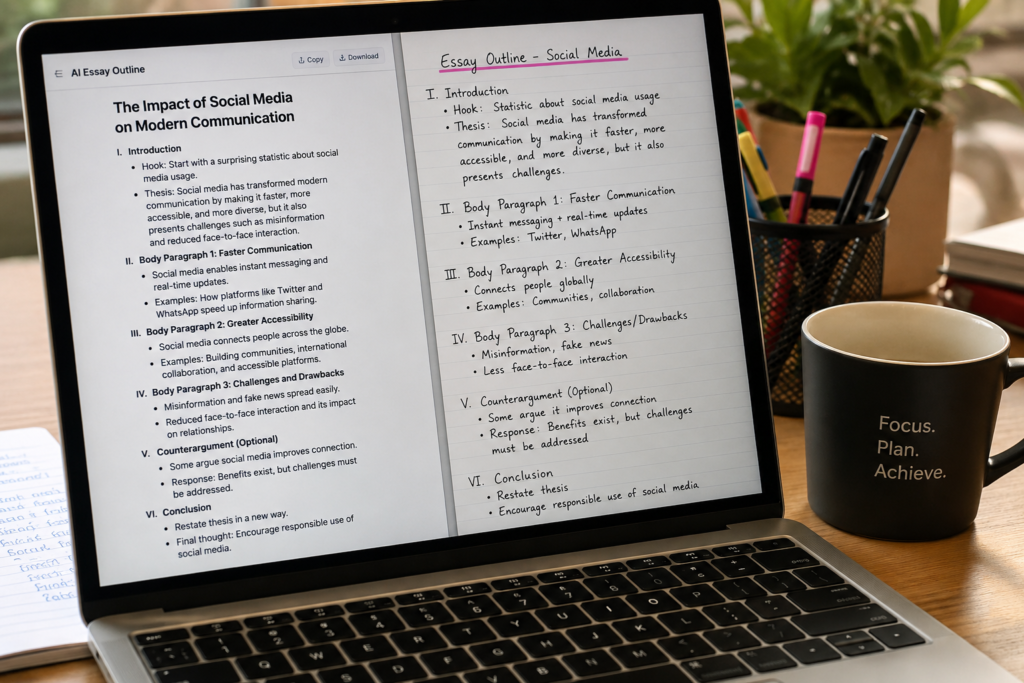
Understanding how to use ChatGPT to outline an essay without sounding AI-generated can help students build better essay structures without losing their personal writing style.
ChatGPT works well for outlining because it organizes information quickly.
Instead of spending an hour wondering how to structure an essay, students can ask ChatGPT to generate possible frameworks within seconds.
This helps students:
• see multiple outline ideas
• organize messy thoughts
• build paragraph structure
• improve logical flow
• reduce blank-page anxiety
But there is something important students need to understand:
ChatGPT is better at structure than originality.
AI can organize ideas effectively, but it often writes in a predictable style.
That is why students should use ChatGPT as:
• a brainstorming assistant
• a structure helper
• an idea organizer
—not as a replacement for personal thinking.
The students who learn how to use ChatGPT to outline an essay without sounding AI-generated usually treat AI as a starting point, not a finished product.
Step-by-Step Workflow: How to Use ChatGPT to Outline an Essay Without Sounding AI-Generated
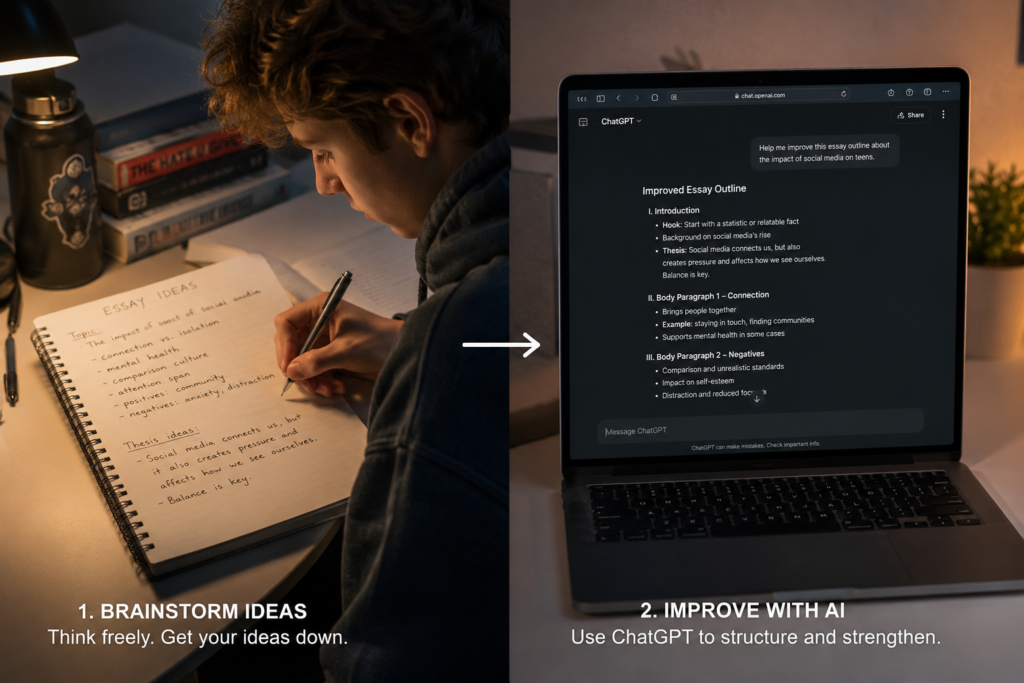
This is the system most students actually need.
Not random tips.
A repeatable workflow.
Step 1: Start With Your Own Basic Idea First
Before opening ChatGPT, spend 3–5 minutes thinking independently.
Ask yourself:
• What is the essay topic?
• What do I already believe?
• What examples come to mind?
• What argument feels strongest?
Even rough thoughts help.
Students who skip this step usually end up with generic AI-generated essays because they never add personal direction.
Example:
Instead of asking:
| “Write me an outline about social media.”
Try:
| “I want to argue that social media improves communication for students but also increases distraction during schoolwork.”
That gives ChatGPT something more specific and human to work with.
Step 2: Ask ChatGPT for Multiple Outline Options
One mistake students make is accepting the first outline instantly.
A better strategy is asking for multiple approaches.
Example prompt:
| “Create 3 possible essay outlines for a high school essay about how social media affects students. Make each structure slightly different.”
This helps students compare:
• stronger arguments
• paragraph order
• thesis directions
• essay flow
Sometimes the second or third outline works much better than the first.
Step 3: Combine the Best Parts Yourself
This is where essays start sounding human again.
Do not copy one full AI outline exactly.
Instead:
• take one intro idea
• combine another body structure
• add your own examples
• remove weak arguments
• rearrange sections naturally
Think of ChatGPT like LEGO pieces.
You build the final structure yourself.
That alone dramatically reduces the “AI-written” feeling.
Step 4: Rewrite the Outline in Simpler Language
AI outlines often sound too formal.
Example of robotic AI wording:
| “The pervasive influence of social media platforms significantly alters adolescent interpersonal communication patterns.”
Most high school students do not naturally write like that.
A more human version:
| “Social media changes how teenagers communicate with friends and classmates every day.”
Same idea.
Much more natural.
One of the biggest secrets in learning how to use ChatGPT to outline an essay without sounding AI-generated is simplifying language instead of trying to sound overly academic.
Step 5: Add Personal Thinking and Real Examples
AI-generated outlines often feel emotionally empty.
Students can fix this by adding:
• classroom experiences
• realistic examples
• school situations
• opinions
• observations
Example:
Instead of:
| “Students experience distractions due to technology.”
Try:
| “Many students open TikTok for five minutes during homework and suddenly lose an hour.”
That feels real because it reflects actual student behavior.
Step 6: Create Flexible Paragraph Notes Instead of Full AI Paragraphs
This is extremely important.
Instead, create short paragraph guidance like:
• Paragraph 1 → introduce problem
• Paragraph 2 → benefits
• Paragraph 3 → drawbacks
• Paragraph 4 → balance and conclusion
Then write the actual paragraphs yourself.
This keeps your voice natural.
It also helps students avoid sounding robotic during school assignments.
Bad vs Good Example of an AI Essay Outline
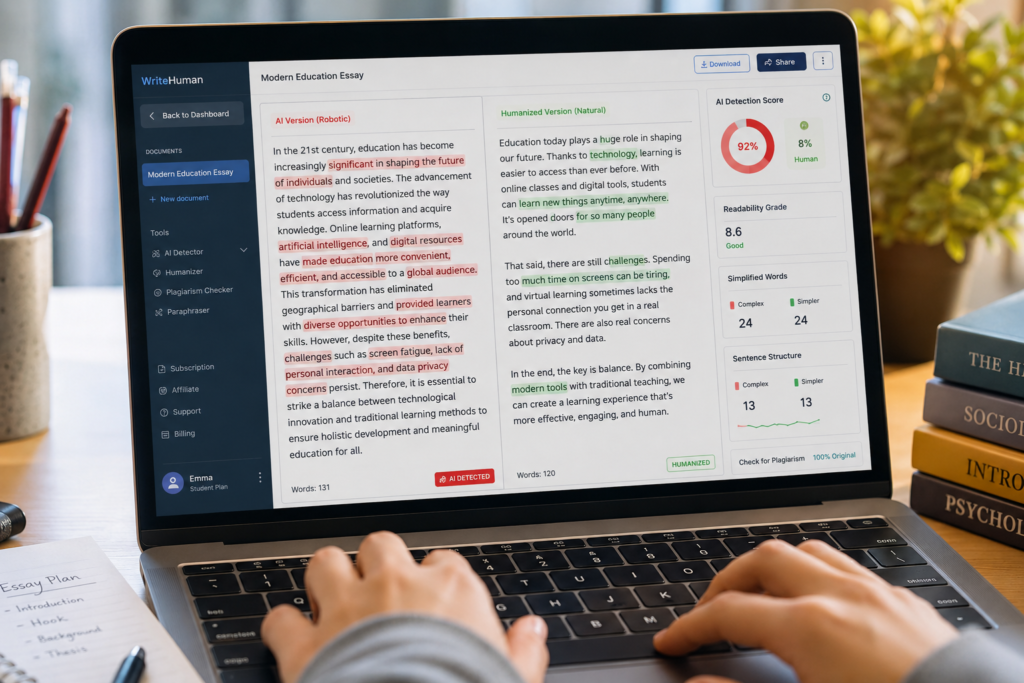
Students often understand faster when they see comparisons.
Bad AI-Generated Outline Example
Topic: School Uniforms
Introduction
• School uniforms are important in education.
Body Paragraph 1
• Uniforms improve discipline.
Body Paragraph 2
• Uniforms reduce bullying.
Conclusion
• Uniforms are beneficial overall.
Why this sounds weak:
• generic
• predictable
• emotionally flat
• no personality
• no real student perspective
Better Humanized Outline Example
Topic: School Uniforms
Introduction
• Describe a student worrying about expensive clothing trends at school.
• Introduce debate around uniforms.
Body Paragraph 1
• How uniforms reduce social pressure and comparison.
Body Paragraph 2
• Situations where uniforms improve classroom focus.
Body Paragraph 3
• Counterargument: students want self-expression.
Conclusion
• Balanced opinion with realistic perspective.
Why this works better:
• feels human
• includes emotion
• sounds realistic
• shows personal understanding
• avoids robotic structure
This difference matters a lot when learning how to use ChatGPT to outline an essay without sounding AI-generated.
Bad AI Usage vs Smart AI Usage
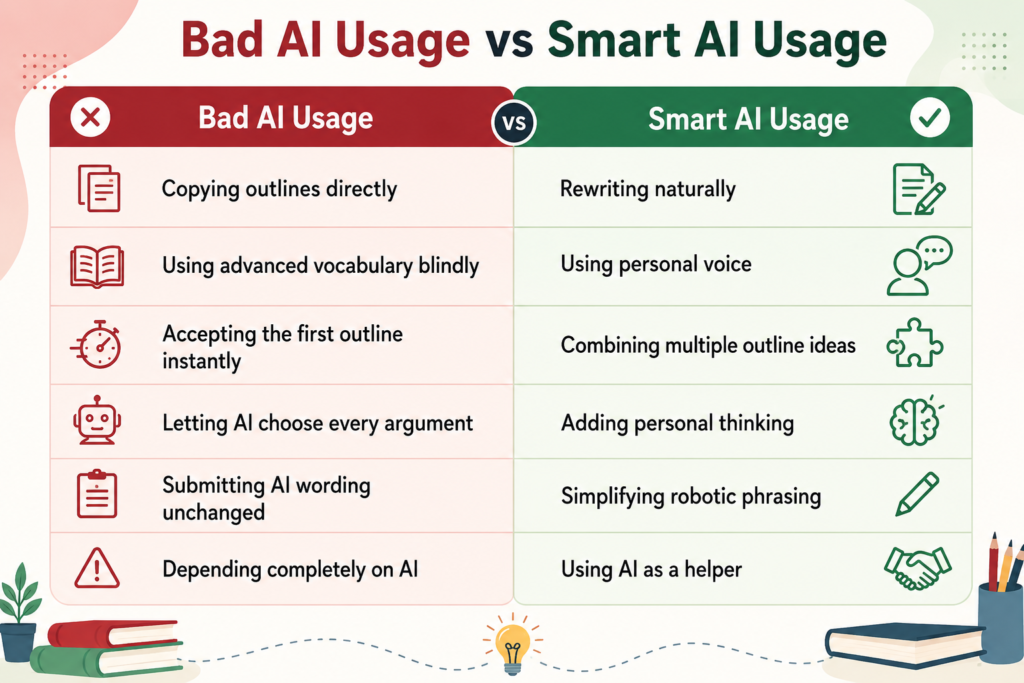
| Bad AI Usage | Smart AI Usage |
| Copying outlines directly | Rewriting naturally |
| Using advanced vocabulary blindly | Using personal voice |
| Accepting the first outline instantly | Combining multiple outline ideas |
| Letting AI choose every argument | Adding personal thinking |
| Submitting AI wording unchanged | Simplifying robotic phrasing |
| Depending completely on | Using AI as a helper |
Humanization Techniques That Make Essays Sound Natural
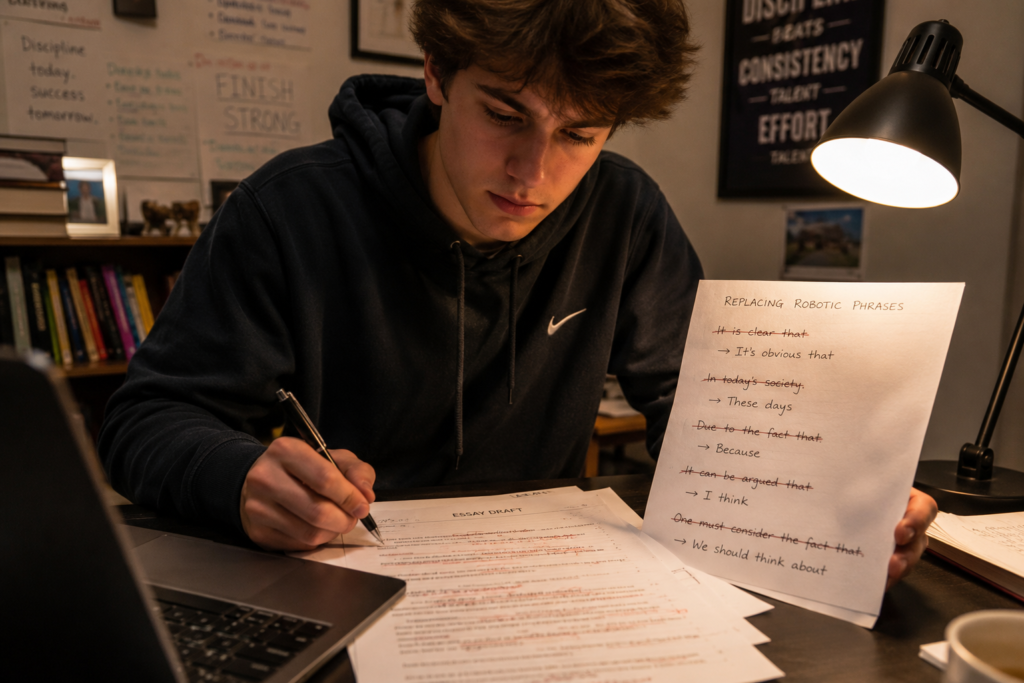
This is the section most competing articles completely miss.
Students do not just need AI prompts.
They need humanization systems.
Simplify Overly Academic Sentences
AI often sounds too polished.
Students should simplify sentences intentionally.
Example:
AI style:
| “The implementation of digital educational technologies facilitates enhanced academic efficiency.”
Human style:
| “Technology can help students finish schoolwork faster.”
Simple writing often sounds more believable.
Mix Sentence Length Naturally
Robotic essays often use repetitive sentence patterns.
Human writing sounds more natural when sentence lengths vary.
Example:
• short sentence
• medium explanation
• longer reflective sentence
That rhythm feels realistic.
Add Small Human Observations
Tiny observations make essays feel authentic.
Examples:
• “Most students know this feeling.”
• “That usually happens during finals week.”
• “A lot of teenagers struggle with this.”
These details sound personal instead of machine-generated.
Use Your Own Vocabulary
Students sometimes leave advanced AI vocabulary unchanged.
That creates obvious problems because teachers recognize sudden writing-level changes.
If you would never naturally say:
| “multifaceted socioeconomic implications”
then do not keep it.
Use language that actually sounds like you.
Leave Some Imperfect Natural Flow
Perfect AI writing often feels suspicious.
Human writing includes:
• natural transitions
• slightly uneven rhythm
• emotional phrasing
• conversational moments
Ironically, slightly imperfect writing can sound more authentic than flawless AI text.
One of the biggest skills in learning how to use ChatGPT to outline an essay without sounding AI-generated is knowing how to rewrite robotic phrasing naturally.
Best ChatGPT Prompts for Essay Outlines
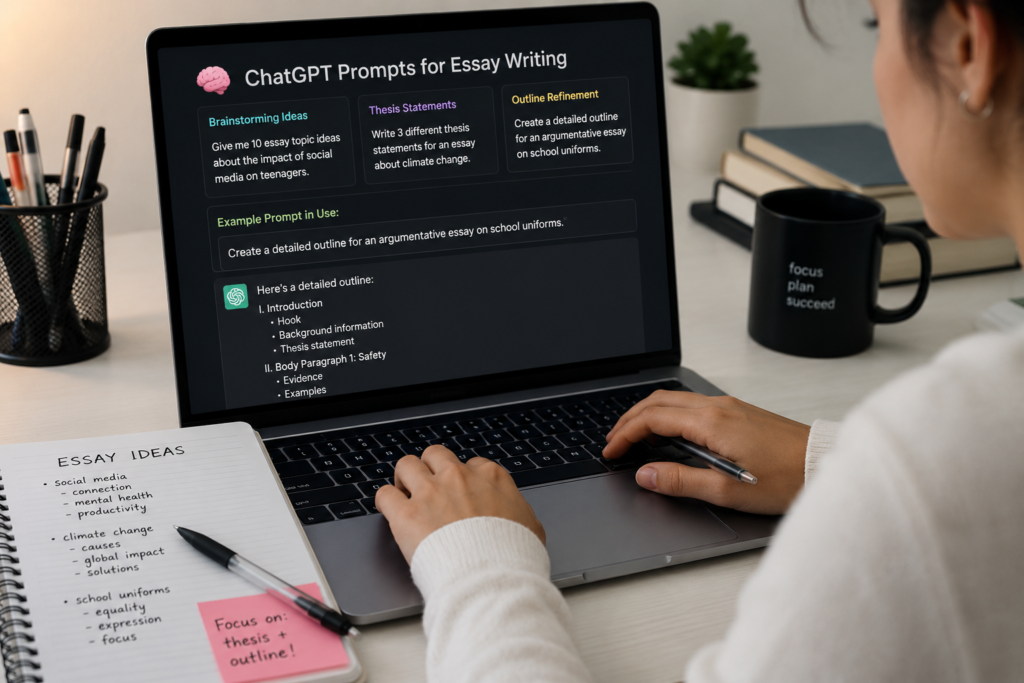
Students learning how to use ChatGPT to outline an essay without sounding AI-generated should focus on brainstorming and organization instead of copying complete outlines.
Students usually get much better results when prompts are specific instead of vague.
Brainstorming Prompt
| “Give me 5 interesting argument ideas for a high school essay about social media and teenagers.”
Thesis Statement Prompt
| “Help me create a strong but natural-sounding thesis statement for an essay about school uniforms.”
Essay Outline Prompt
| “Create 3 different outline structures for a high school essay about climate change. Keep the structure simple and realistic for a student essay.”
Humanization Prompt
| “Rewrite this outline in simpler and more natural language so it sounds like a real high school student wrote it.”
Refinement Prompt
| “Help me improve this essay outline without making it sound overly academic or AI-generated.”
Common Mistakes Students Make With ChatGPT Essay Outlines
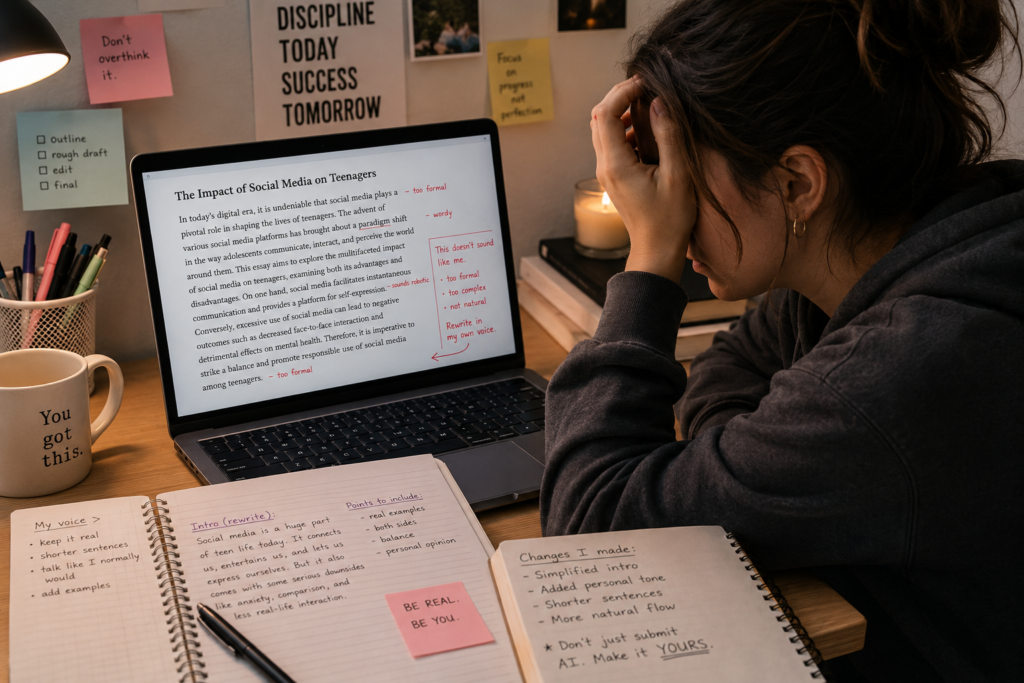
Copying the Entire Outline Directly
This is the biggest mistake.
Teachers can often recognize generic AI structure quickly because thousands of students generate similar outlines.
Using Vocabulary That Does Not Match Their Grade Level
A sudden jump from simple writing to advanced academic language looks suspicious.
Students should always rewrite AI wording naturally.
Letting AI Choose Every Argument
AI should help organize thinking, not replace thinking entirely.
Strong essays still require personal judgment.
Skipping the Revision Process
Some students paste AI outlines directly into essays without reviewing flow or logic.
That creates awkward writing.
Trusting AI Blindly
ChatGPT sometimes:
• invents facts
• creates weak arguments
• misunderstands prompts
• gives repetitive structures
Students should always think critically.
Responsible Use: AI as a Helper, Not a Replacement
There is a major difference between:
using AI to improve learning
and
letting AI completely replace learning.
The smartest students use ChatGPT to:
• reduce stress
• organize ideas
• improve clarity
• brainstorm faster
• build confidence
But they still:
• think independently
• revise carefully
• rewrite naturally
• add personal understanding
Teachers usually care more about genuine learning than whether students used brainstorming help responsibly.
The problem starts when students stop thinking for themselves.
Students who struggle with essay outlines may also benefit from guides about AI homework tools, AI essay writing assistants, and productivity systems that help students manage assignments faster and reduce deadline stress.
• “AI essay writing assistants”
FAQ
This guide explains how to use ChatGPT to outline an essay without sounding AI-generated using a practical student-friendly workflow.
Can teachers detect AI-generated essay outlines?
Teachers usually notice when essays sound overly robotic, generic, or inconsistent with a student’s normal writing style. Human rewriting and personal examples make essays feel much more natural.
Is using ChatGPT for essay outlines cheating?
Using ChatGPT for brainstorming or structure is usually different from copying full essays directly. Students should still create original writing in their own words.
How do students make AI writing sound more human?
Students can:
• simplify language
• rewrite AI phrasing
• add personal examples
• vary sentence structure
• remove robotic wording
What is the best ChatGPT prompt for essay outlines?
A strong prompt is:
| “Create 3 possible essay outlines for a high school essay about [topic]. Include different thesis directions and paragraph structures.”
Should students fully trust ChatGPT essay structures?
No. Students should review arguments carefully because AI-generated structures are sometimes repetitive or weak.
How do students use ChatGPT for essay outlines without sounding AI-generated?
Students should combine multiple AI outline ideas, simplify robotic wording, add personal examples, and rewrite everything naturally in their own voice.
Conclusion

Students who understand how to use ChatGPT to outline an essay without sounding AI-generated usually produce essays that feel more natural, organized, and authentic.
Learning how to use ChatGPT to outline an essay without sounding AI-generated is really about balance.
AI can help students:
• organize ideas faster
• reduce writer’s block
• improve essay structure
• manage stressful deadlines
• feel less overwhelmed during assignments
But strong essays still come from human thinking.
The students who use AI most effectively are usually not the students copying everything automatically.
They are the students who:
• question ideas
• rewrite naturally
• simplify robotic wording
• add personal perspective
• use AI as a guide instead of a replacement
A good outline should make writing easier.
It should still sound like you.
A strong essay is not about sounding like AI. It is about sounding clear, thoughtful, and genuinely human.
Pingback: Best AI Tools to Improve English Writing for Students (2026 Guide)
Pingback: Best AI Tools for Students to Proofread and Edit Their Own Essays (2026 Guide)