Last Updated: May 2026
Quick Answer
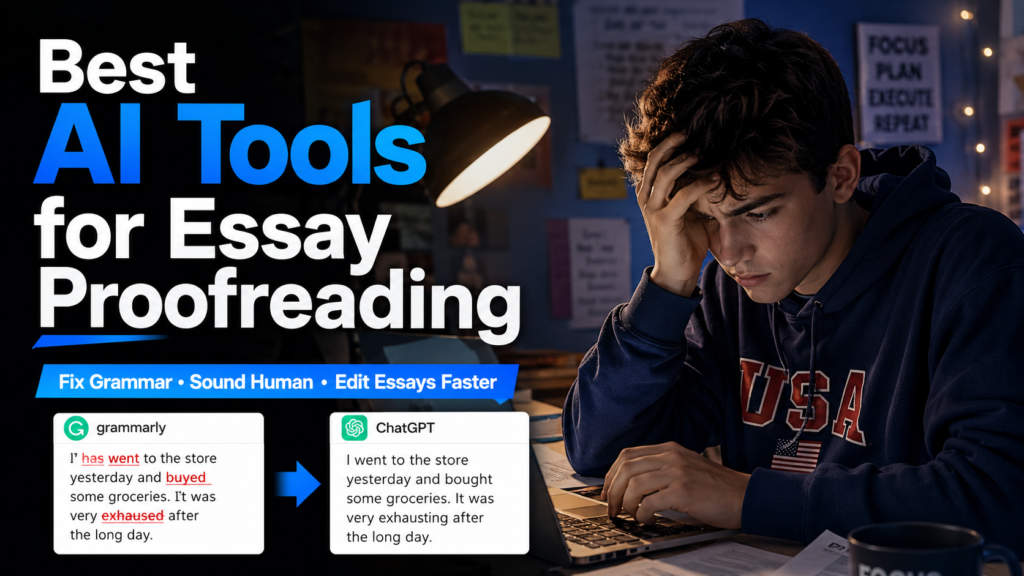
The best AI tools for students to proofread and edit their own essays AI proofreading tools can help students catch grammar, spelling, punctuation, and wording problems, while AI editing and revision tools can improve clarity, organization, transitions, and thesis structure. Tools such as Grammarly, ChatGPT, QuillBot, Claude, and Google Gemini can support different stages of the process. However, students should review every important suggestion and keep their own argument, evidence, voice, and final judgment.
Introduction
It usually starts the same way.
A student opens Google Docs at 10:47 PM with an essay due before midnight.
The ideas are there somewhere. Sort of.
But the introduction sounds awkward. The grammar feels off. One paragraph repeats the same phrase three times. Another sentence somehow became almost impossible to read after editing it five different ways.
So the student does what most students do now.
They open Grammarly.
Then ChatGPT.
Then maybe QuillBot.
Then they spend twenty minutes rewriting the same sentence because now it sounds too robotic.
This is where things get difficult.
A lot of students searching for the best AI tools for students to proofread and edit their own essays are not trying to cheat. They are trying to survive assignment pressure while still sounding natural and human.
That is what this guide is about.
Not generic AI hype.
Not “10 tools that will magically write essays for you.”
A real student workflow.
A practical system students can actually use during stressful assignment nights without sounding AI-generated.
Most students also need to understand that proofreading, editing, and revision are not the same thing.
Proofreading focuses on surface-level errors such as grammar, spelling, punctuation, typos, and small formatting issues.
Editing goes deeper by improving sentence clarity, wording, flow, paragraph structure, repetition, and readability.
Revision goes deeper still. It asks whether the thesis is clear, whether the argument is organized logically, whether evidence supports the main point, and whether the essay actually answers the assignment.
AI can assist with all three, but it should not treat them as interchangeable tasks. A grammar correction does not automatically improve an argument, and rewriting a sentence does not necessarily mean the underlying idea has been revised.
This guide therefore focuses on the complete process: Proofreading → Editing → Revision → Academic Writing Review → Verification. You will learn which AI tools are useful for each stage, how to use them without losing your writing voice, what AI should not change, and how to review suggestions before submitting an essay.
Who This Guide Is For
This guide is especially useful for:
• students with weak grammar confidence
• high school students struggling with essays
• beginner writers who overthink every sentence
• ESL learners trying to sound more natural
• students overwhelmed by multiple assignments
• students afraid teachers will detect AI writing
• students who freeze while proofreading essays
• students who know their ideas are good but struggle to express them clearly
A lot of students are smarter than their writing currently sounds.
That gap creates frustration.
AI tools can help close it when used correctly.
Many students searching for the best AI tools for students to proofread and edit their own essays are looking for practical editing help rather than essay-writing shortcuts.
AI Proofreading vs Editing vs Essay Revision
Proofreading
Proofreading is the final surface-level check for errors such as grammar, spelling, punctuation, typos, capitalization, and minor formatting issues.
An AI proofreader can quickly identify many of these problems, but students should still review suggested changes because automated corrections can sometimes alter tone or meaning.
Editing
Editing goes beyond correcting mistakes.
It focuses on:
- Sentence clarity
- Word choice
- Sentence structure
- Paragraph flow
- Repetition
- Transitions
- Readability
- Consistency
The goal is not simply to make an essay sound more sophisticated. The goal is to make the student’s existing ideas clearer and easier to understand.
Revision
Revision is deeper than proofreading or editing.
It asks:
- Is the thesis clear?
- Does the argument make sense?
- Are ideas organized logically?
- Does each paragraph support the main point?
- Is the evidence relevant?
- Are important points missing?
- Does the conclusion follow from the discussion?
AI can help students identify possible weaknesses, but revision requires substantially more judgment than proofreading.
| Stage | Main Question | AI Can Help With |
|---|---|---|
| Proofreading | Are there surface-level errors? | Grammar, spelling, punctuation, typos |
| Editing | Is the writing clear? | Wording, sentence structure, flow |
| Revision | Is the thinking and argument strong? | Thesis, organization, argument structure |
Proofreading fixes errors. Editing improves expression. Revision improves the underlying work.
Signs Students Are Struggling With Essay Proofreading and Editing
Some signs are obvious.
Others are subtle.
Awkward Sentences
You reread the sentence three times and it still feels strange.
Repetitive Wording
Every paragraph somehow uses the same words repeatedly.
Weak Introductions
The essay starts too generic or sounds forced.
Confusing Paragraph Flow
Ideas make sense in your head but not on the screen.
Robotic Writing
The essay suddenly sounds overly formal or unnatural after AI editing.
Grammar Insecurity
Students keep checking Grammarly after almost every paragraph because they no longer trust their own writing.
Most students experience at least a few of these problems regularly.
Why Students Struggle With Essay Editing
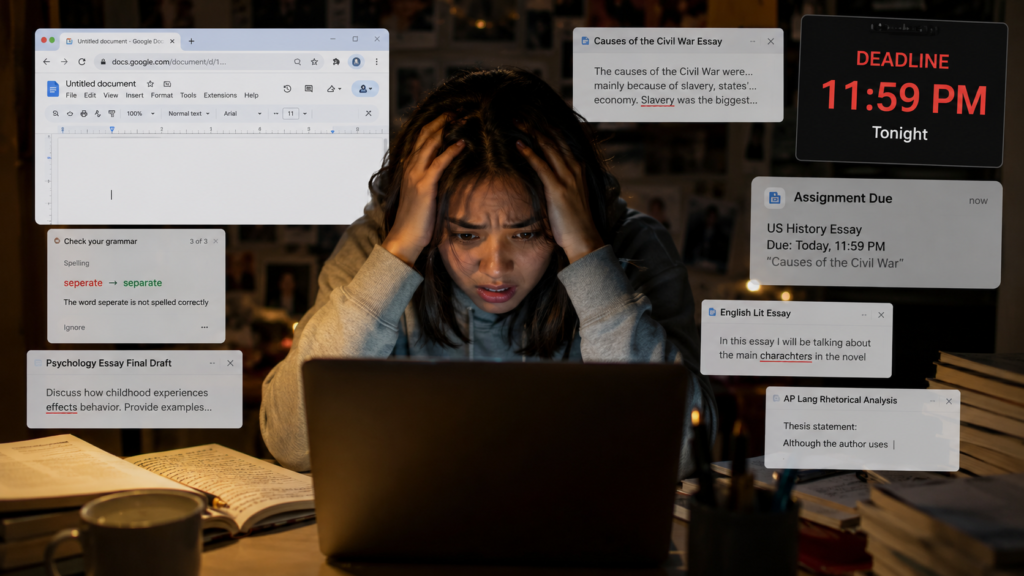
Essay editing sounds easy until you are exhausted at night staring at your own writing.
Then every sentence starts looking wrong.
Procrastination
Many students start assignments late, leaving little energy for proper proofreading.
Perfectionism
Some students keep rewriting the same introduction repeatedly because they want every sentence to sound perfect.
Sometimes the essay becomes worse after too many edits.
Weak Confidence
Students with weaker English skills often second-guess every sentence.
Burnout
During exam weeks, even basic proofreading feels mentally exhausting.
Fear of Mistakes
Some students avoid editing entirely because they are afraid of making the essay worse.
AI Confusion
Students use AI tools but do not know:
• what to trust
• what to rewrite
• what sounds robotic
• what teachers might notice
Here’s the problem.
Most students were never actually taught how to edit essays properly.
How AI Tools Can Actually Help Students
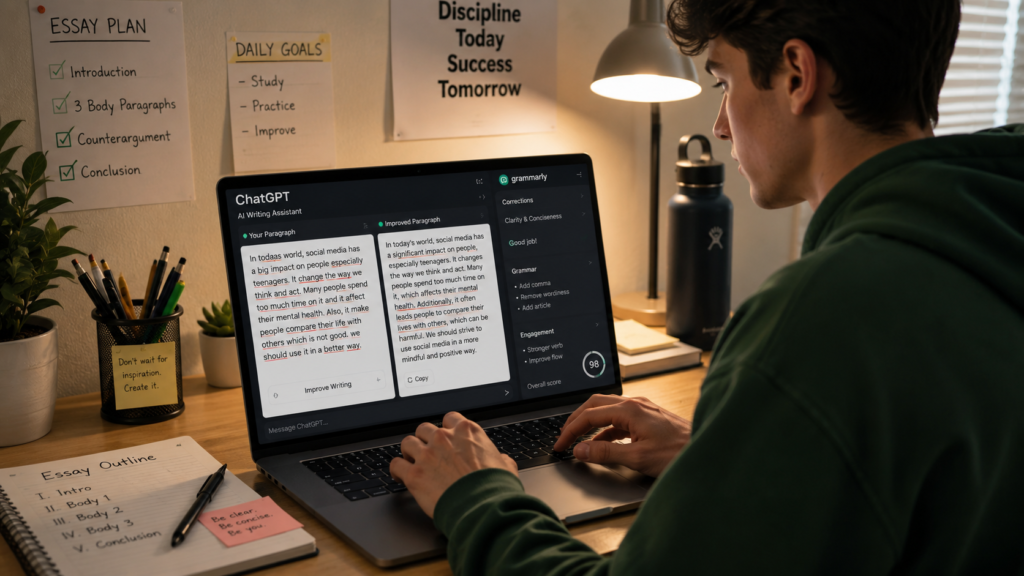
AI tools work best as assistants.
Not replacements.
The best AI tools for students to proofread and edit their own essays help students:
• catch grammar mistakes
• improve clarity
• organize paragraphs
• simplify awkward wording
• brainstorm stronger phrasing
• reduce proofreading stress
• improve writing confidence
But this is important.
AI should support your thinking — not replace it.
Students struggling with essay structure may also benefit from guides about AI essay outlining workflows and proofreading AI writing naturally for more human-sounding assignments.
The students who benefit most from AI usually:
• rewrite AI suggestions
• simplify robotic edits
• keep their personal voice
• understand their final submission
That creates stronger essays.
And safer essays.
This is why the best AI tools for students to proofread and edit their own essays are often used for revision and clarity instead of generating complete essays.
Students who struggle with essay structure before editing may also find our guide on How to Use ChatGPT to Outline an Essay Without Sounding AI-Generated helpful for creating stronger first drafts.
Can You Use AI to Proofread an Essay?
Yes, students can use AI to assist with proofreading an essay, but whether they are allowed to do so depends on the instructor, course, school, or university policy.
AI proofreading can help identify:
- Grammar mistakes
- Spelling errors
- Punctuation problems
- Repeated words
- Awkward sentences
- Basic clarity issues
- Inconsistent wording
However, proofreading should not mean handing the entire essay to AI and accepting every change automatically.
Students should also remember that language proofreading does not automatically verify:
An essay can be grammatically perfect and still contain incorrect information.
So the answer to “Can I use AI to proofread my essay?” is not simply yes or no.
AI can assist with proofreading when your course rules allow it, but the student remains responsible for reviewing the changes and ensuring the final essay is accurate and genuinely reflects their own work.
How to Proofread an Essay With AI
Proofreading works best as a separate final-stage process rather than something students mix into every step of writing.
Draft Your Essay
Finish your own draft before asking AI to polish every sentence.
The goal is to preserve your original thinking before automated suggestions influence the wording.
Review Your Argument
Before fixing commas or sentence structure, ask:
- Is my thesis clear?
- Does each paragraph support my argument?
- Is my evidence relevant?
- Does the conclusion match the argument?
This is revision, not proofreading.
Grammar Check
Now use an appropriate AI proofreading tool to identify:
- Grammar
- Spelling
- Punctuation
- Typos
- Basic sentence errors
Improve Clarity
Review suggestions involving:
- Wordiness
- Awkward wording
- Unclear sentences
- Weak transitions
Do not automatically accept every suggested rewrite.
Check Repetition
Ask AI to identify repeated words, phrases, or ideas.
Then decide which repetitions are actually problems. Some repetition is intentional in academic writing.
Review AI Suggestions
Read every meaningful change.
Did this correction preserve what I actually meant?
If not, reject or modify it.
Verify Facts and Citations Separately
Proofreading is not fact-checking.
Verify important:
- Facts
- Citations
- Quotes
- Statistics
- Research claims
Use appropriate sources for verification.
Final Human Review
Read the complete essay without focusing only on highlighted corrections.
- Does this still sound like me?
- Does it answer the assignment?
- Does the argument make sense?
- Do I understand everything I am submitting?
That final review turns AI-assisted proofreading into a responsible editing process.
Can AI Revise a College Essay?
AI can assist with revising a college essay, but revision should mean improving the student’s existing ideas—not replacing the student’s thinking with an entirely AI-written essay.
Revision can involve much more than grammar.
Improving Thesis Clarity
AI can help identify whether your thesis is:
- Clear
- Specific
- Relevant to the assignment
- Consistent with the rest of the essay
“Review my thesis and explain whether it clearly communicates my main argument. Do not rewrite it automatically. Suggest specific improvements while preserving my intended meaning.”
Improving Organization
AI can review the structure of an essay and identify possible organizational problems.
It can help students consider:
- Whether paragraphs appear in a logical order
- Whether ideas repeat
- Whether important points are missing
- Whether the introduction prepares the reader for the argument
- Whether the conclusion follows logically
The student should decide whether a structural change actually improves the argument.
Strengthening Transitions
AI can identify abrupt transitions between paragraphs or ideas.
Instead of asking AI to rewrite the entire essay, ask it to identify where the logical connection between ideas is unclear.
This keeps the student’s original writing intact while making the structure easier to follow.
Identifying Repetition
AI can help locate:
- Repeated arguments
- Repeated phrases
- Duplicate explanations
- Paragraphs that make essentially the same point
The student can then decide whether to remove, combine, or keep the material.
Reviewing Argument Structure
AI can act as a second reader by asking questions such as:
- Does the evidence support the claim?
- Are there logical gaps?
- Are counterarguments addressed where necessary?
- Does the conclusion reflect the evidence?
However, AI should identify potential issues rather than invent evidence to fix them.
This distinction matters.
Students should follow their instructor’s AI policy before using AI for either process.
The student remains the author and decision-maker throughout the process.
Using AI to Proofread Academic Writing
AI proofreading can be useful beyond traditional college essays. Students may also use AI to review the language and organization of different types of academic writing when their course or institution permits it.
However, proofreading language is different from verifying whether the academic content itself is correct.
College Essays
AI can help identify grammar mistakes, awkward wording, unclear sentences, repetition, and basic readability issues.
Students should still make sure that the final essay reflects their own argument and personal reasoning.
Research Papers
For research papers, AI can assist with language clarity, sentence structure, transitions, and organization.
It should not be treated as a replacement for checking research sources, citations, statistics, or factual claims.
Assignments
Students can use AI to identify writing problems in assignments when permitted.
For example, AI can point out unclear sentences or repetitive explanations without automatically rewriting the entire assignment.
Discussion Posts
AI can help students check grammar and readability before posting.
However, students should preserve their own ideas and follow any course-specific rules about AI assistance.
Lab Reports
AI can assist with proofreading the language of a lab report, including grammar, clarity, and organization.
It should not invent experimental observations, measurements, results, calculations, or scientific conclusions.
Literature Reviews
AI can help improve the clarity and organization of a literature review.
But students must independently verify:
- Sources
- Citations
- Research claims
- Study findings
- Publication details
- Interpretation of evidence
An AI proofreader can improve how an academic claim is written. It does not automatically verify whether the claim is true.
What AI Proofreading Does Not Verify
Students should remember that proofreading primarily concerns language.
It does not automatically confirm:
- Whether a citation is genuine
- Whether a source supports the claim
- Whether a statistic is correct
- Whether research findings are represented accurately
- Whether a methodology is appropriate
- Whether an argument is logically valid
- Whether the assignment satisfies the instructor’s requirements
Proofread the language with AI. Verify the academic content separately.
Best AI Tool by Essay Task
Different essay tasks require different types of AI assistance. A tool that is excellent at catching grammar mistakes may not be the best option for reviewing an essay’s argument or organization.
Instead of choosing one tool for everything, match the tool to the task.
| Essay Task | Recommended Tool | Why |
|---|---|---|
| Grammar & punctuation | Grammarly | Strong focus on surface-level writing corrections |
| Sentence clarity | Grammarly / ChatGPT | Useful for identifying unclear or awkward wording |
| Rewording | QuillBot | Useful for exploring alternative wording |
| Essay editing | ChatGPT / Claude | Useful for broader writing feedback |
| Essay revision | ChatGPT / Claude | Can review thesis, organization, and argument structure |
| Academic writing review | ChatGPT / Grammarly | Useful for clarity, tone, and academic style |
| Final proofreading | Grammarly / ChatGPT | Useful for a final language-focused review |
Grammar & Punctuation
For straightforward grammar, spelling, punctuation, and typo checking, a dedicated writing assistant can be more convenient than a general-purpose AI chatbot.
Sentence Clarity
When a sentence is grammatically correct but difficult to understand, AI can help identify unnecessary complexity, awkward wording, or unclear structure.
The student should choose the final wording rather than automatically accepting a rewrite.
Rewording
QuillBot and general AI assistants can suggest alternative ways to express an existing idea.
Use this carefully.
The rewritten version should preserve the original meaning and should not introduce information that was not present in the student’s work.
Essay Editing
Broader editing requires more than grammar correction.
Tools such as ChatGPT or Claude can help students review:
- Sentence flow
- Paragraph organization
- Repetition
- Transitions
- Clarity
- Consistency
Essay Revision
Revision requires looking at the essay as an argument rather than simply as a collection of sentences.
AI can help identify possible weaknesses in:
- Thesis clarity
- Organization
- Evidence
- Logical connections
- Paragraph purpose
The student must make the final revision decisions.
Academic Writing Review
For academic writing, AI can help identify unclear language, excessive repetition, informal wording, or inconsistent terminology.
However, students should separately verify research claims and citations.
Final Proofreading
A final proofreading pass should happen after substantive revisions are complete.
- Grammar
- Spelling
- Punctuation
- Typos
- Formatting
- Remaining awkward sentences
This prevents students from repeatedly proofreading sentences that they later rewrite during revision.
Simple rule: Match the AI tool to the writing task, review meaningful suggestions, and keep the final decision with the student.
Best AI Tools for Proofreading and Editing Essays
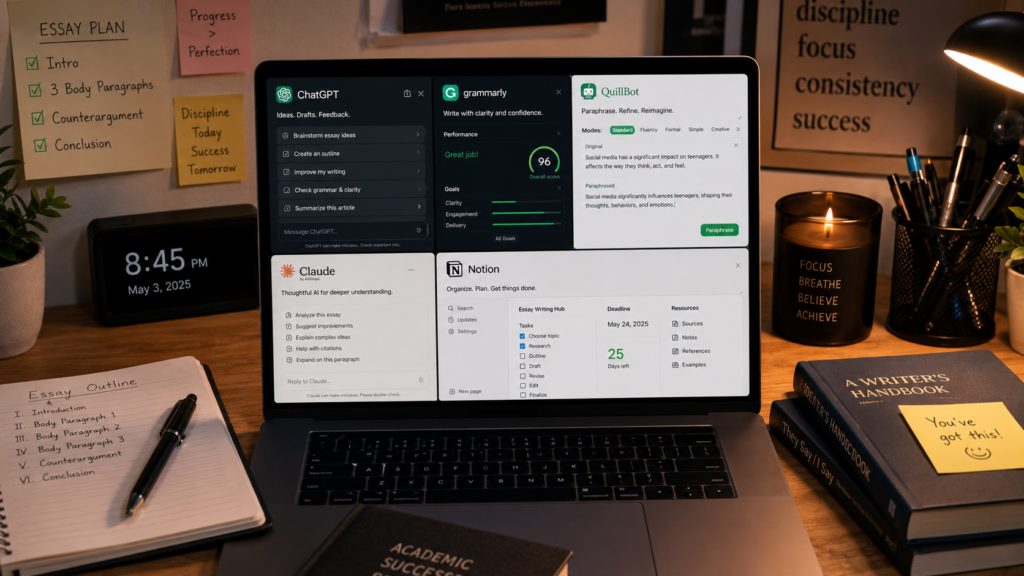
The best AI essay proofreading tool depends on what you need to improve. Some tools are primarily designed to catch grammar and punctuation errors, while others are better suited to rewriting, editing, revision, or broader academic writing feedback.
For students, the goal should not be to find the tool that changes the most words. The better tool is the one that helps improve the writing while preserving the student’s meaning, evidence, and voice.
Grammarly
Overview
Grammarly is primarily a writing assistant designed to help users identify and improve issues involving grammar, spelling, punctuation, clarity, tone, and other aspects of written communication.
For students, it fits particularly well into the proofreading and editing stages of an essay workflow.
Best For
Proofreading
Useful for catching surface-level writing problems before submission.
Editing
Can help identify wording and clarity issues that go beyond basic grammar.
Revision
It can provide writing suggestions, but students should not rely on it as their primary tool for evaluating a thesis or complete argument.
Pros
- Easy to use
- Strong proofreading focus
- Useful for students who want quick writing feedback
- Convenient for final review
Cons
- Suggestions still require human judgment
- Not a substitute for substantive academic review
- Some advanced capabilities depend on the current plan
Pricing / Free Option
Grammarly offers free and paid options, with available features varying by plan. Verify current pricing before publishing.
Ideal Student
Students who primarily need help with grammar, clarity, punctuation, and final proofreading.
Important Limitation
Grammarly can improve language, but it cannot guarantee that an essay’s argument, evidence, citations, or factual claims are correct.
Official Website
Visit the official Grammarly website for current features, pricing, and product information.
ChatGPT
Overview
ChatGPT can support multiple stages of the essay workflow, including proofreading, editing, revision, and academic writing feedback.
Its conversational format allows students to give specific instructions about what they want reviewed.
Best For
Proofreading
Ask it to identify grammar, spelling, punctuation, and clarity issues without rewriting the essay unnecessarily.
Editing
It can review sentence structure, repetition, transitions, and readability.
Revision
It can help students examine thesis clarity, paragraph organization, argument structure, and logical gaps.
Pros
- Flexible
- Useful across multiple writing stages
- Can explain why a change is suggested
- Useful for conversational feedback
Cons
- Can make unnecessary changes
- May introduce unsupported information if poorly prompted
- Students must review suggestions carefully
Pricing / Free Option
ChatGPT has multiple plans, and feature availability can vary. Check current official pricing and capabilities before publishing.
Ideal Student
Students who want one flexible AI assistant for proofreading, editing, and revision.
Official Website
Visit the official ChatGPT website for current features, plans, and product information.
Visit ChatGPT →Important Limitation
Never assume an AI-generated revision is automatically correct. Verify factual claims, citations, and changes to meaning.
QuillBot
Overview
QuillBot is particularly relevant when students want help rephrasing or improving the wording of existing text.
Best For
Proofreading
It can support certain writing corrections depending on the current feature set.
Editing
Useful when a sentence communicates the right idea but needs clearer wording.
Revision
Less suitable as the primary tool for deep argument-level revision.
Pros
- Useful for rewording
- Easy for sentence-level editing
- Helpful for exploring alternative phrasing
Cons
- Rewording does not automatically improve an argument
- Students must verify that meaning has not changed
- Some capabilities are limited by plan
Pricing / Free Option
QuillBot offers free and paid options with different feature limits. Verify current pricing before publication.
Ideal Student
Students who mainly need sentence-level rewording or clarity assistance.
Official Website
Visit the official QuillBot website for current features, plans, and product information.
Visit QuillBot →Important Limitation
Do not use paraphrasing simply to make someone else’s ideas appear original. Sources must still be properly cited.
Claude
Overview
Claude can provide detailed conversational feedback on writing and can be useful for reviewing larger sections of an essay.
Best For
Proofreading
It can identify language problems when explicitly instructed to focus on proofreading.
Editing
Useful for reviewing paragraph flow, wording, transitions, and consistency.
Revision
It can help students think through thesis structure, organization, and argument clarity.
Pros
- Detailed feedback
- Useful for longer writing reviews
- Good for structured critique
Cons
- Suggestions can still be subjective
- Students need to verify changes
- Not a substitute for instructor feedback
Pricing / Free Option
Claude offers different access levels and plans. Verify current pricing and feature availability before publishing.
Ideal Student
Students working on longer essays or academic writing who want detailed feedback.
Official Website
Visit the official Claude website for current features, plans, and product information.
Visit Claude →Important Limitation
Claude should help evaluate and improve the student’s work, not replace the student’s reasoning or generate unsupported academic claims.
Google Gemini
Overview
Google Gemini can help students review, explain, and improve written content while also supporting broader research and productivity workflows within Google’s ecosystem.
Best For
Proofreading
It can identify common grammar and clarity problems.
Editing
Students can ask Gemini to identify awkward wording, repetition, and structural issues.
Revision
It can help brainstorm ways to strengthen organization or clarify an argument while keeping the student’s original intent.
Pros
- Flexible AI assistant
- Useful for explanations
- Convenient for students using Google’s ecosystem
- Can support multiple writing stages
Cons
- AI suggestions require review
- Feature availability varies
- Not a replacement for academic feedback
Pricing / Free Option
Gemini availability and advanced features vary by Google account and plan. Verify current information before publication.
Ideal Student
Students who already use Google tools and want a general-purpose AI assistant for writing support.
Official Website
Visit the official Google Gemini website for current features, availability, and product information.
Visit Google Gemini →Important Limitation
Gemini should not be trusted to independently verify every fact, citation, or academic claim in an essay.
AI Proofreading Tools Comparison Table
Different tools are useful for different stages of essay improvement. A dedicated proofreader may be better for grammar and punctuation, while a general AI assistant can provide broader editing and revision feedback.
| Tool | Best For | Proofreading | Editing | Revision | Academic Writing | Free Option | Main Limitation |
|---|---|---|---|---|---|---|---|
| Grammarly | Grammar & proofreading | Strong | Strong | Limited | Strong | Yes | Not a replacement for deep argument review |
| ChatGPT | Editing & revision | Strong | Strong | Strong | Strong | Availability varies | Suggestions require careful verification |
| QuillBot | Rewording & paraphrasing | Useful | Strong | Limited | Useful | Yes | Rewording does not equal substantive revision |
| Claude | Detailed editing & feedback | Strong | Strong | Strong | Strong | Availability varies | Requires human judgment |
| Google Gemini | General writing assistance | Strong | Strong | Useful | Useful | Availability varies | Features and access can vary |
Best Tool for Grammar and Punctuation
Grammarly is a natural choice when the primary goal is catching surface-level writing errors.
Best Tool for Essay Editing
ChatGPT or Claude can be useful when the student wants feedback that goes beyond grammar and considers sentence clarity, paragraph flow, and organization.
Best Tool for Rewording
QuillBot is particularly useful when students need alternative wording while preserving an existing idea.
Best Tool for Essay Revision
ChatGPT or Claude can help students examine thesis clarity, organization, argument structure, and logical flow.
However, the student—not the AI—should decide what changes actually improve the argument.
Best Tool for Academic Writing Review
Grammarly, ChatGPT, Claude, or Gemini can each be useful depending on the specific task.
For research-heavy academic writing, remember that writing feedback does not automatically verify the accuracy of sources, citations, statistics, or research claims.
The best AI proofreading tool is not necessarily the one with the most features. Choose the tool that matches the specific writing task, then review its suggestions before accepting them.
What AI Should NOT Change in Your Essay
AI can improve wording and identify writing problems, but not every part of an essay should be treated as something that needs optimization.
Your essay contains ideas, experiences, evidence, and decisions that may be intentionally expressed in a particular way. AI suggestions should not automatically override those choices.
Core Argument
AI should not change the central argument simply because it thinks another position sounds stronger.
If your instructor expects you to defend a particular position, the argument should remain yours.
AI can point out weaknesses in reasoning, but you should decide how to address them.
Thesis Meaning
AI can help improve thesis clarity, but it should not silently change what your thesis actually claims.
If the answer is no, reject the suggestion.
Personal Experiences
For college essays that include personal experiences, AI should not invent, exaggerate, or alter events.
Your experiences should remain accurate.
AI can help improve grammar and clarity, but it should not create experiences that did not happen.
Evidence
AI should not add evidence simply because a paragraph appears to need stronger support.
If additional evidence is required, research it separately and verify the source.
Never allow AI to invent statistics, examples, quotations, or research findings.
Research Findings
If your essay discusses research, AI should not change the findings to make your argument sound stronger.
Unexpected or inconvenient findings are still part of the evidence.
Citations
AI should not invent or alter citations without verification.
- Author
- Publication
- Date
- Title
- DOI or URL where applicable
- Whether the source actually supports the claim
Intended Meaning
A sentence may be awkward but still communicate an important idea.
Before accepting an AI rewrite, make sure the suggested version preserves the original meaning.
Deliberate Style Choices
Not every unusual sentence is an error.
Students may intentionally use:
- A particular tone
- A personal voice
- A rhetorical question
- A specific phrase
- A deliberate stylistic structure
AI suggestions should be evaluated rather than automatically accepted.
The Student’s Voice
AI should help you communicate your ideas more clearly—not replace your voice with generic language.
Your final essay should still represent your own thinking, experiences, and understanding.
Improve the writing without erasing the writer.
Academic Integrity: Proofreading vs Editing vs Revision vs AI-Generated Writing
Using AI to improve an essay is not automatically the same as asking AI to write the essay.
The important difference is what the AI is doing and what your course or institution allows.
AI-Assisted Proofreading
Proofreading generally focuses on surface-level corrections such as:
- Grammar
- Spelling
- Punctuation
- Typos
- Basic clarity
If your instructor permits AI assistance, this can be a relatively limited use of AI.
However, you should still review the suggestions and make sure they do not change your intended meaning.
AI-Assisted Editing
Editing goes beyond proofreading.
It can involve:
- Sentence structure
- Word choice
- Flow
- Transitions
- Repetition
- Readability
Because editing can affect how your ideas are expressed, students should review every substantial change.
AI-Assisted Revision
Revision can involve much more substantial decisions about:
- Thesis
- Organization
- Argument
- Evidence
- Paragraph structure
AI can provide feedback or identify potential weaknesses, but students should remain responsible for deciding how their work should change.
AI-Generated Writing
Having AI generate substantial portions of an essay is different from asking it to identify grammar mistakes or provide feedback.
Whether this is permitted depends on the assignment and institution.
Do not assume that because an AI tool can generate text, you are allowed to submit that text as your own academic work.
Check Your Course AI Policy
Before using AI on an academic essay, check the rules provided by:
- Your instructor
- Your course syllabus
- Your school
- Your college
- Your university
- Your research program
Policies can differ significantly. Some instructors may allow proofreading assistance but restrict AI-generated writing. Others may require students to disclose AI use.
Keep Responsibility With the Student
Regardless of how much assistance an AI tool provides, students should remain responsible for:
- The accuracy of their work
- Their argument
- Their evidence
- Their citations
- Their interpretation
- Their final submission
Use AI as an assistant when permitted—not as a substitute for your academic responsibility.
Best Tool Based on Student Situation
Choosing the best AI tools for students to proofread and edit their own essays depends heavily on the specific writing problem a student is trying to solve.
| Student Problem | Recommended Tools |
| Weak grammar | Grammarly + ChatGPT |
| Robotic writing | Claude + QuillBot |
| Poor organization | Notion + Todoist |
| Homework overload | Todoist + ChatGPT |
| Weak essay structure | ChatGPT + Claude |
| Awkward phrasing | QuillBot + Grammarly |
Free vs Paid AI Tools — What Students Actually Need
Most high school students honestly do not need expensive subscriptions immediately.
Free plans are often enough for:
• grammar fixing
• proofreading
• brainstorming
• simple editing
Paid plans become more useful when students:
• write constantly
• need deeper revisions
• manage large workloads
But this is important.
Many students searching for the best AI tools for students to proofread and edit their own essays improve significantly before ever needing premium subscriptions.
Before vs After Examples
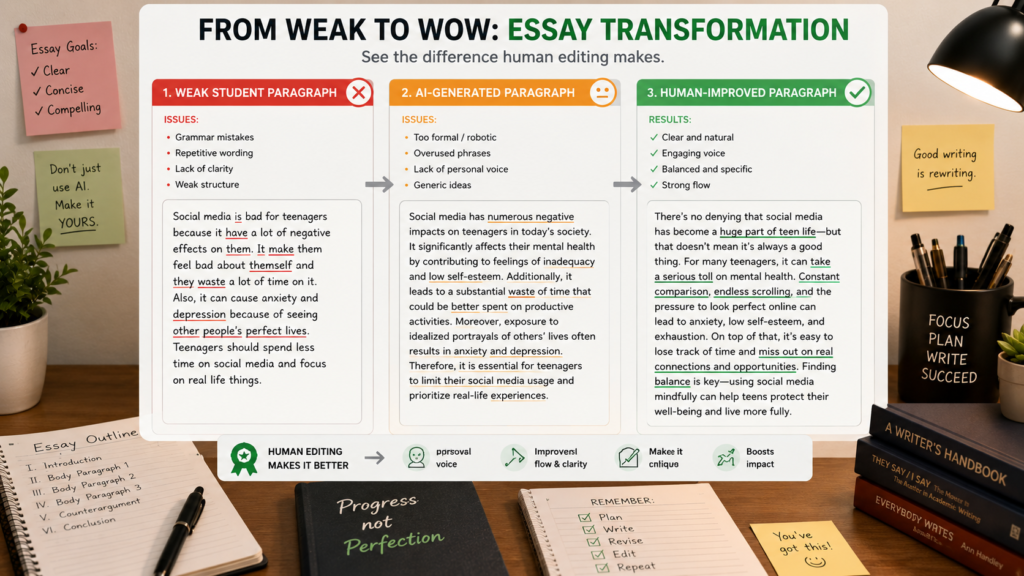
Weak Writing Example
“Social media is bad because students use phones a lot and this causes many distractions in school.”
Robotic AI Example
“The pervasive utilization of social media platforms significantly contributes to the deterioration of student academic concentration and productivity metrics.”
Improved Human Version
“Social media can distract students during homework and studying, especially when notifications constantly interrupt focus.”
Why does the third version sound better?
Because it:
• sounds natural
• uses realistic wording
• feels believable
• avoids trying too hard
How Students Accidentally Sound AI-Generated
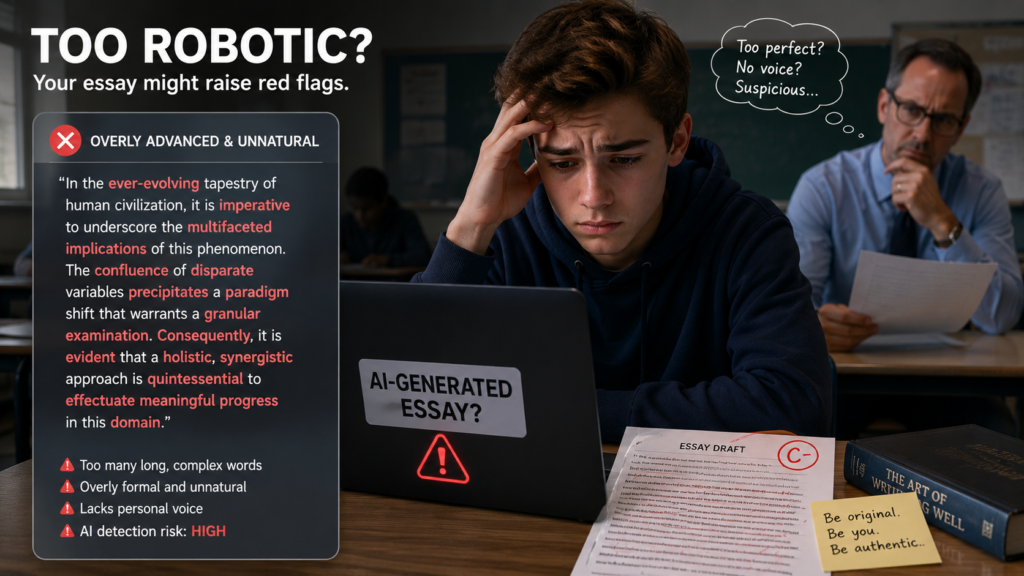
Students often think “smarter vocabulary” equals better writing.
Usually it does not.
Common problems:
• advanced vocabulary overload
• emotionless tone
• repetitive transitions
• unnatural phrasing
• overly polished sentences
Sometimes essays stop sounding like students entirely.
That is usually what teachers notice first.
How to Make AI Writing Sound More Human
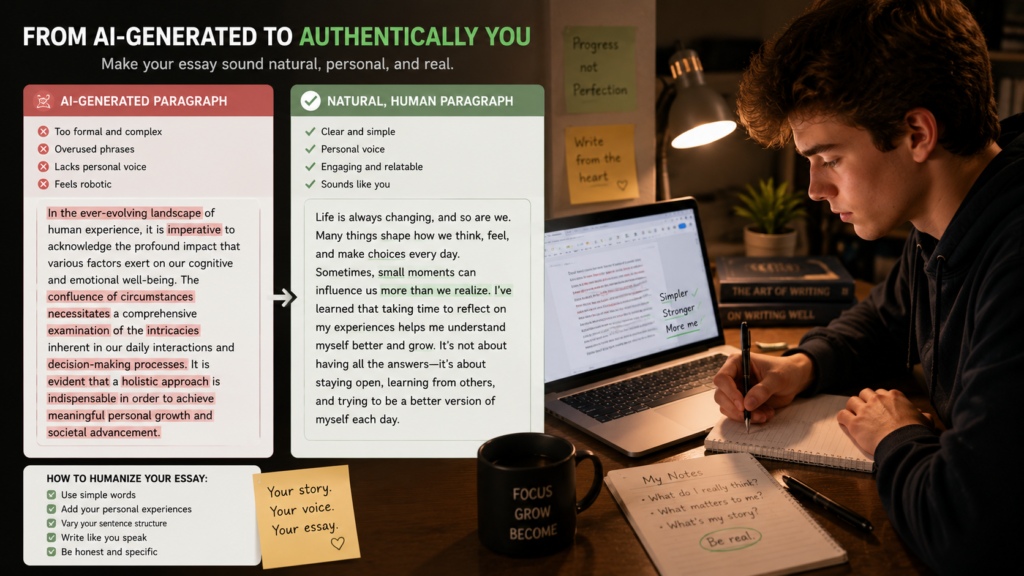
Simplify Vocabulary
Use words you would realistically say.
Add Personal Voice
Even small observations help.
Mix Sentence Lengths
Not every sentence should sound perfectly balanced.
Remove Robotic Transitions
Too many:
• “Furthermore”
• “Moreover”
• “In conclusion”
can sound artificial quickly.
Add Realistic Examples
Real student situations make essays sound more believable.
Students trying to improve productivity may also find AI study planner workflows useful when managing long writing assignments.
How to Verify an AI-Proofread Essay
AI can identify many writing problems, but proofreading suggestions should still be reviewed before an essay is submitted.
A final verification pass helps ensure that improving the language has not accidentally changed the student’s meaning or introduced new problems.
Compare Important Changes With Your Original
Read substantial AI suggestions alongside the original sentence.
Did the correction preserve what I meant?
If a suggested rewrite changes the meaning, reject or modify it.
Check Facts Separately
AI proofreading does not guarantee that factual claims are correct. Verify important:
- Facts
- Statistics
- Dates
- Names
- Research findings
- Technical claims
Use appropriate original or authoritative sources.
Verify Citations
Check that every important citation:
- Actually exists
- Contains accurate publication information
- Supports the claim being made
- Uses the required citation style
Check Research Claims
An AI tool may improve the wording of a research statement without determining whether the statement accurately represents the underlying study.
Return to the original source when a claim matters to your argument.
Check the Thesis and Argument
After proofreading, reread the essay as a complete argument.
- Does my thesis still mean what I intended?
- Does the evidence support my claims?
- Did any AI change weaken or alter my reasoning?
- Does the conclusion still match the argument?
Read the Final Essay Yourself
The final review should not be performed entirely by AI. Read the complete essay from beginning to end.
Make sure:
- The writing makes sense
- Your voice remains present
- Your argument is accurate
- The evidence is represented honestly
- You understand every sentence you are submitting
Final Verification Rule
Use this simple sequence before submitting your essay:
The AI can suggest a correction. You decide whether the correction is actually correct.
Keep the Final Decision Human
AI can help identify possible writing improvements, but the student should remain responsible for deciding which changes are accurate, appropriate, and consistent with the original work.
Common Mistakes Students Make When Using AI to Proofread Essays
AI proofreading can save time, but students can easily misuse it by accepting every suggestion without understanding what changed. The biggest problems usually happen when students treat proofreading as automatic rewriting.
Accepting Every AI Suggestion
AI suggestions are not automatically correct.
A change that looks grammatically better may alter the meaning, tone, or emphasis of your sentence.
Asking AI to Rewrite the Entire Essay
A request such as “rewrite my entire essay and make it better” can produce changes far beyond proofreading.
It may alter:
- Your argument
- Your writing voice
- Your examples
- Your intended meaning
- Your paragraph structure
Using AI to Change the Argument
If an AI tool suggests a different position because it sounds more persuasive, that does not mean your original argument was wrong.
Trusting AI With Facts
Grammar feedback does not guarantee factual accuracy. Students should separately verify:
- Facts
- Statistics
- Research claims
- Quotes
- Citations
- Sources
Accepting Invented Citations
Never assume that an AI-generated citation is genuine.
Removing Personal Voice
Academic writing does not need to sound robotic.
If an AI suggestion makes your essay sound generic or unlike your normal writing, reconsider it.
Ignoring Instructor Rules
A tool being technically capable of proofreading an essay does not mean your assignment permits it.
Confusing Proofreading With Revision
Fixing grammar will not automatically fix a weak thesis or poorly organized argument.
Revision → Editing → Proofreading
Perform each stage intentionally rather than asking AI to change everything at once.
The goal of AI proofreading is not to make every sentence sound different. It is to help identify genuine writing problems while preserving your ideas, voice, meaning, and academic responsibility.
How to Use AI Without Cheating
Responsible AI use usually follows this process:
Understand → Revise → Write
- Understand suggestions
- Revise awkward sections
- Write naturally in your own voice
AI works best when students:
• learn from corrections
• rewrite suggestions
• keep original thinking
Students interested in responsible AI writing may also benefit from guides about proofreading AI writing naturally and humanizing AI-assisted essays.
What Teachers Actually Notice
Teachers usually notice:
• sudden vocabulary jumps
• robotic tone shifts
• inconsistent writing quality
• unnatural phrasing
• emotionless paragraphs
Ironically, students trying hardest to “sound smart” often sound most artificial.
Real-Life Student Example
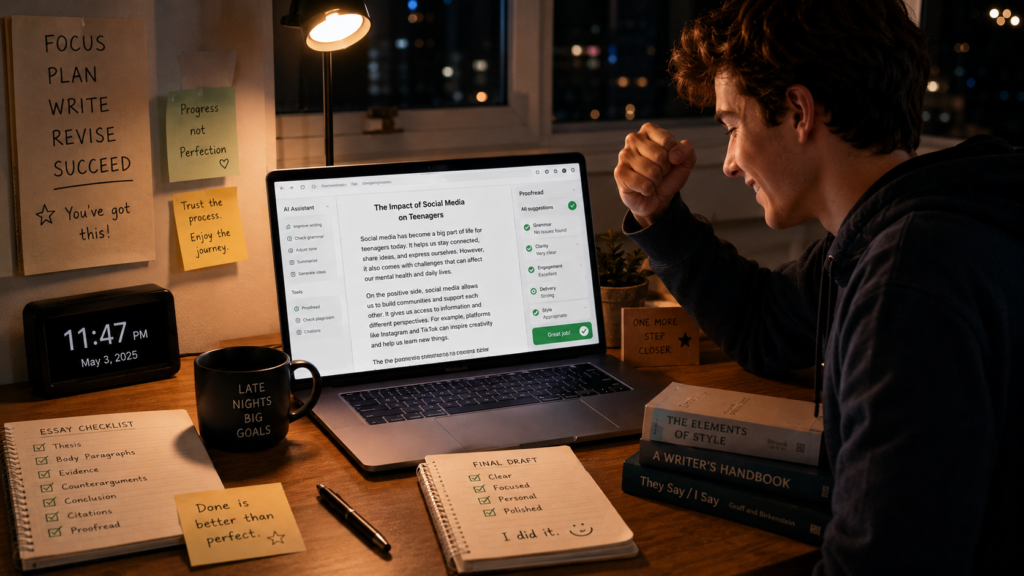
A high school student had an argumentative essay due at midnight.
At 9:30 PM they still had only half an introduction.
The grammar felt weak.
Every paragraph sounded awkward.
So they used:
• ChatGPT for brainstorming
• Grammarly for proofreading
• Claude AI for tone improvement
At first they copied too much AI wording.
The essay sounded robotic immediately.
Then they slowed down.
They rewrote sections naturally. They simplified vocabulary. They added realistic examples.
The final essay was not perfect.
But it sounded real.
That usually matters more.
Fastest Improvements Students Usually Notice
Students often notice:
• fewer grammar mistakes
• clearer sentence structure
• better confidence
• faster essay editing
• less procrastination
• lower proofreading stress
The best AI tools for students to proofread and edit their own essays are usually the ones that reduce mental overwhelm while still helping students keep their own voice.
AI Proofreading Prompts
Good prompts make AI less likely to rewrite an essay unnecessarily. Instead of asking an AI tool to “fix my essay,” students should clearly define what they want reviewed and what the AI must preserve.
Every prompt below is designed to keep the student’s argument, voice, meaning, and evidence intact.
Grammar and Punctuation Check
“Proofread the essay below for grammar, spelling, punctuation, capitalization, and obvious typos. Preserve my argument, meaning, evidence, and writing voice. Do not rewrite sentences unnecessarily. For each important correction, briefly explain what was changed and why. If you are uncertain about a correction, flag it instead of making the change automatically.”
Sentence Clarity Review
“Review my essay for unclear, awkward, or unnecessarily complicated sentences. Preserve my original meaning and writing voice. Identify the sentences that may confuse a reader and explain why. Suggest a clearer alternative only when necessary. Do not add new information.”
Repetition Check
“Identify repeated words, phrases, ideas, or arguments in my essay. Do not automatically remove them. Explain which repetitions may weaken the writing and which may be intentional. Preserve my argument and meaning.”
Academic Writing Review
“Review this essay for academic writing quality. Check clarity, sentence structure, transitions, consistency, unnecessary repetition, and overly informal wording. Preserve my ideas, evidence, citations, and voice. Do not invent information or citations.”
Thesis Review
“Review my thesis statement and explain whether it clearly communicates my main argument. Do not rewrite it automatically. Identify any ambiguity or weakness and suggest possible improvements while preserving my intended meaning.”
Organization Review
“Review the organization of my essay. Identify paragraphs that may be out of logical order, repetitive, or insufficiently connected to my thesis. Do not rewrite the essay. Explain the structural issue and suggest what I should consider changing.”
Transition Review
“Review the transitions between paragraphs in my essay. Identify places where the connection between ideas is unclear or abrupt. Preserve my writing style and suggest minimal changes where needed. Do not add new arguments.”
Discussion and Argument Review
“Review my argument for logical consistency. Identify claims that may need stronger evidence or clearer explanation. Do not invent evidence, statistics, citations, or research findings. Clearly distinguish between a writing issue and a factual or research issue that I need to verify separately.”
Final Proofreading Review
“Perform a final proofreading review of this essay. Focus only on grammar, spelling, punctuation, typos, sentence clarity, and obvious consistency problems. Preserve my voice, argument, evidence, and intended meaning. Do not unnecessarily rewrite my sentences. Flag anything that requires factual or citation verification rather than assuming it is correct.”
Safe All-Purpose Proofreading Prompt
“Act as a careful academic proofreader. Review my essay without replacing my writing or changing my argument. Identify grammar, spelling, punctuation, clarity, repetition, and sentence-structure issues. Preserve my voice and intended meaning. Do not invent information, evidence, quotations, statistics, or citations. Do not change factual claims unless you identify them as needing verification. Explain important suggested changes and flag uncertain suggestions. Keep revisions minimal and necessary.”
FAQ
Yes, AI can help identify grammar, spelling, punctuation, clarity, and wording issues. However, whether you are allowed to use AI for proofreading depends on your instructor, course, school, or university policy. Review every suggestion and make sure it preserves your intended meaning.
Not necessarily. Proofreading assistance may be permitted in some courses and restricted in others. The important question is what your instructor or institution allows. Check the applicable AI policy before using an AI proofreader and disclose AI assistance when required.
AI can help review thesis clarity, organization, transitions, repetition, and argument structure. However, revision should remain the student’s responsibility. AI should not invent experiences, evidence, research findings, or arguments.
AI proofreading focuses mainly on grammar, spelling, punctuation, typos, and basic errors. AI editing goes further by addressing wording, sentence structure, clarity, flow, and readability. Neither automatically verifies the accuracy of an essay’s argument or research.
The best option depends on the task. Grammarly is particularly useful for proofreading and language corrections, while ChatGPT and Claude can provide broader editing and revision feedback. Students should choose based on their specific needs and course requirements.
Yes, if prompted carefully. Ask the tool to correct grammar and punctuation while preserving your voice, meaning, and sentence style. Review important suggestions manually because even a well-intentioned correction can sometimes change the original meaning.
Yes. AI proofreading does not guarantee that facts, statistics, citations, research claims, or sources are accurate. Verify important academic information separately using appropriate sources.
Continue Learning
If you want to take your academic workflow beyond essay proofreading, explore these related IndiaAITools guides:
AI Tools for Automatic Lecture Notes
Turn lectures into organized, review-friendly notes.
AI Tools for Reading PDFs for Students
Understand and summarize lengthy academic PDFs more efficiently.
Best AI Tools for Creating Lab Reports for Students
Use AI responsibly across lab-report writing, data analysis, and scientific writing.
AI Tools for Academic Research
Support research, source discovery, and academic information gathering.
Conclusion
AI can make essay proofreading and editing much easier, but the most useful approach is not to let AI rewrite everything for you. Instead, use AI at the stage where it can provide the most value.
Tools such as Grammarly, ChatGPT, QuillBot, Claude, and Google Gemini can support different parts of this process. The best choice depends on whether you need a grammar check, sentence-level editing, broader revision feedback, or academic writing assistance.
But AI suggestions should never replace your judgment.
Before submitting an essay, review important changes, verify facts and citations separately, and make sure the final version still represents your own ideas, evidence, meaning, and voice.
Check your instructor’s or institution’s AI policy before using these tools. AI proofreading may be permitted in one course and restricted in another.
The goal is not to make your essay sound like it was written by AI.
The goal is to make your own writing clearer, more accurate, and easier to understand while keeping responsibility for the final work with you.
If you use AI thoughtfully, AI essay proofreading → editing → revision → verification can become a practical part of a responsible academic writing workflow.