
Quick Answer
Students can use AI tools like Elicit, Consensus, ResearchRabbit, Semantic Scholar, NotebookLM, Scite, Claude AI, ChatGPT, and Zotero to simplify literature reviews. These tools help discover relevant research papers, compare studies, identify research gaps, organize evidence, summarize academic articles, and manage citations while allowing students to focus on analysis rather than repetitive research tasks.
Introduction
Writing a literature review is one of the most demanding parts of academic writing.Unlike a standard essay or research assignment
Unlike a standard essay or research assignment, a literature review requires you to read multiple research papers, compare different viewpoints, identify recurring themes, evaluate evidence, and explain how previous studies relate to your research question.
For many students, this is where the research process becomes overwhelming.
You search for one paper.
Then another.
Soon, you have dozens of browser tabs open, twenty PDF files downloaded, and pages of notes that no longer seem organized.
Instead of understanding the research, you spend most of your time searching, highlighting, and trying to remember which paper discussed which idea.
This is exactly where artificial intelligence can make a meaningful difference.
The Best AI Tools for Literature Review for Students are not designed to replace critical thinking or academic reading. Instead, they simplify repetitive research tasks such as discovering relevant studies, summarizing papers, comparing findings, organizing notes, identifying research gaps, and managing citations.
When used responsibly, AI allows students to spend less time on manual organization and more time understanding research, evaluating evidence, and writing stronger literature reviews.
Students who consistently use the Best AI Tools for Literature Review for Students often save hours of manual work while producing more organized and evidence-based literature reviews.
In this guide, you’ll discover the most effective AI tools for literature reviews in 2026, learn when to use each one, avoid common mistakes, and follow a practical workflow that helps you complete literature reviews faster without compromising academic quality.
Definition Box
Literature Review Definition
A literature review is a structured analysis of published research on a specific topic. Instead of simply summarizing individual papers, it compares existing studies, identifies common themes, highlights conflicting evidence, discovers research gaps, and explains how previous research supports a new academic project.
What Is a Literature Review?

A literature review is much more than reading academic papers.
It is a process of understanding how previous researchers have investigated a topic and how those findings relate to one another.
A strong literature review answers questions such as:
• What has already been discovered?
• Which conclusions appear consistently across studies?
• Where do researchers disagree?
• What limitations exist in current research?
• Which questions remain unanswered?
Rather than discussing one paper at a time, literature reviews organize research into meaningful patterns.
For example, imagine you are researching artificial intelligence in education.
Instead of writing:
| Paper A says this.
| Paper B says that.
A literature review groups similar findings together.
You might organize your review around themes such as:
• AI improves personalized learning.
• AI increases student engagement.
• Ethical concerns surrounding AI in education.
• Limitations of existing AI learning systems.
This approach demonstrates critical thinking instead of simple summarization.
Learning how to use the Best AI Tools for Literature Review for Students helps organize this process more efficiently while maintaining academic integrity.
Understanding the purpose of a literature review is the first step toward choosing the Best AI Tools for Literature Review for Students for your academic workflow.
Why Literature Reviews Feel Difficult for Students

Students rarely struggle because literature reviews are impossible.
They struggle because literature reviews combine multiple academic skills into one assignment.
Information Overload
One database search can return thousands of papers.
Students often ask:
• Which papers are actually relevant?
• Which studies are outdated?
• Which journals are trustworthy?
• Which papers deserve deeper reading?
Without a strategy, information overload quickly becomes frustrating.
This is one reason why the Best AI Tools for Literature Review for Students have become increasingly valuable for modern academic research.
Too Many Research Papers
Reading one academic paper takes time.
Reading twenty, thirty, or fifty papers requires careful planning.
Many students spend hours downloading PDFs before realizing only a small percentage are actually useful.
Comparing Different Studies
Perhaps the hardest part of a literature review is comparison.
Students must identify:
• Similar findings
• Different conclusions
• Research trends
• Methodological differences
• Contradictory evidence
This requires much more than reading.
It requires analysis.
Identifying Research Gaps
Universities expect students to explain what current research has not yet answered.
Finding research gaps requires comparing multiple studies instead of treating every paper separately.
Many beginners find this challenging because unanswered questions are rarely stated directly.
Organizing Research Notes
Research notes quickly become disorganized.
Students often collect:
• PDFs
• Browser bookmarks
• Screenshots
• Highlighted passages
• Google Docs
• Sticky notes
• Citation lists
Without a structured system, finding information later becomes difficult.
Students who use the Best AI Tools for Literature Review for Students can organize research papers, notes, and supporting evidence much more efficiently, making the writing phase significantly easier.
Citation Management
Even excellent literature reviews lose marks because of incorrect citations.
Students frequently forget:
• Author names
• Publication years
• Journal titles
• DOI numbers
• Page references
Correcting these mistakes at the last minute creates unnecessary stress.
How AI Makes Literature Reviews Faster
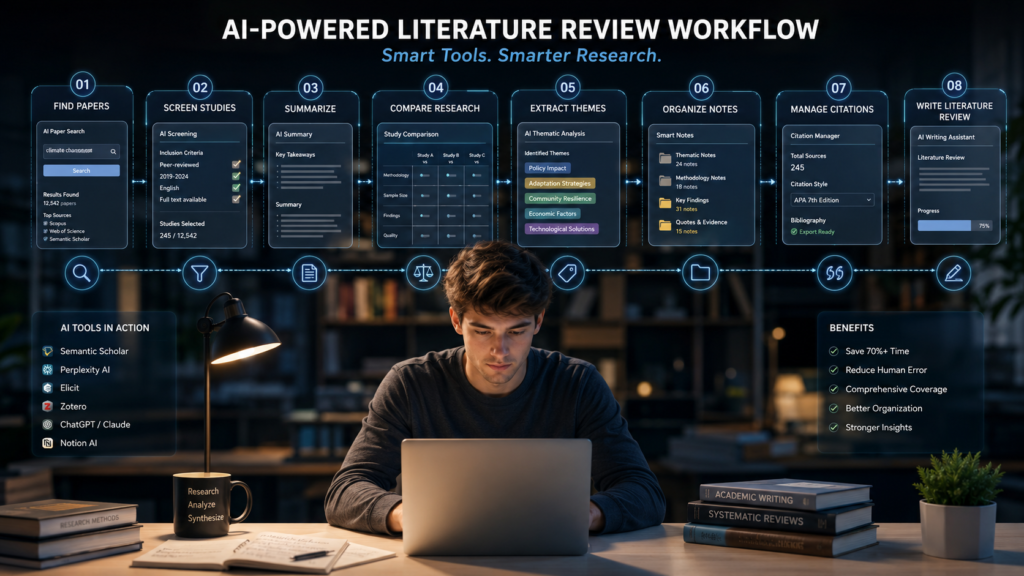
Artificial intelligence cannot replace careful academic reading.
However, it can dramatically improve how students manage research.
Instead of manually performing every repetitive task, AI helps streamline each stage of the literature review process.
AI Literature Review Workflow
The Best AI Tools for Literature Review for Students reduce repetitive research tasks while allowing students to spend more time evaluating evidence and building stronger academic arguments.
Find Relevant Research Papers
↓
Screen Relevant Studies
↓
Summarize Research Papers
↓
Compare Multiple Studies
↓
Identify Themes
↓
Extract Research Gaps
↓
Organize Evidence
↓
Manage Citations
↓
Write Literature Review
Students who follow this workflow usually spend less time searching for information and more time understanding research.
Faster Paper Discovery
Modern AI search tools recommend highly relevant academic papers based on research intent rather than simple keyword matching.
Instead of opening dozens of irrelevant articles, students receive stronger recommendations immediately.
Smarter Screening
Not every paper deserves a full reading.
AI helps summarize abstracts, explain methodologies, and highlight major findings before students invest time reading complete articles.
Better Study Comparison
One of AI’s biggest advantages is recognizing patterns across multiple research papers.
Instead of manually comparing dozens of articles, AI helps identify:
• Common conclusions
• Contradictory findings
• Frequently discussed theories
• Emerging research trends
Organized Evidence
Rather than keeping scattered notes across different applications, AI helps organize research into themes that later become sections of a literature review.
Real Student Example
How Emma Reduced Two Weeks of Research Stress
Emma was preparing a master’s literature review on artificial intelligence in healthcare.
After downloading more than thirty research papers, she realized she had no organized system.
Every study discussed different methodologies, datasets, and conclusions.
Instead of rereading every paper repeatedly, she changed her workflow.
She used AI tools to:
• summarize individual studies,
• group similar findings,
• compare conflicting evidence,
• organize notes into themes,
• track citations more effectively.
The AI didn’t write her literature review.
It removed repetitive tasks, allowing Emma to spend more time analyzing research and developing original academic insights.
Best AI Tools for Literature Review for Students

Every platform offers different strengths, so selecting the Best AI Tools for Literature Review for Students depends on your research topic, academic level, and preferred workflow.
No single AI tool can complete an entire literature review.
The smartest students combine different tools for different stages of the workflow.
Some tools help discover research papers.
Others summarize studies.
Some compare evidence.
Others organize citations.
The Best AI Tools for Literature Review for Students work together to create a faster and more organized research process.
Elicit
Overview
Elicit is an AI-powered academic research assistant specifically designed for literature reviews. Instead of performing a basic keyword search, it searches academic papers, extracts key information, compares studies, and helps students answer research questions.
Best For
• Literature reviews
• Research synthesis
• Finding relevant studies
• Evidence extraction
Pros
• Built specifically for academic research
• Excellent paper comparison
• Identifies research gaps
• Saves hours of manual searching
Cons
• Advanced features require a paid plan
• Best suited for scholarly topics
Pricing
• Free plan available
• Premium subscription available
Student Use Case
A graduate student researching climate change can ask Elicit to compare dozens of published studies instead of reading every paper from scratch.
Many educators consider Elicit one of the Best AI Tools for Literature Review for Students because it was designed specifically for evidence-based academic research.
Consensus
Overview
Consensus searches peer-reviewed research papers and provides evidence-based answers instead of general AI-generated responses.
Best For
• Evidence-backed research
• Fact verification
• Scientific questions
Pros
• Peer-reviewed focus
• Fast research summaries
• Easy to understand
Cons
• Doesn’t replace full paper reading
• Limited outside academic topics
Pricing
• Free
• Premium available
Student Use Case
A nursing student quickly checks whether scientific evidence supports a healthcare claim before including it in a literature review.
Semantic Scholar
Overview
Semantic Scholar is one of the world’s largest AI-powered academic search engines.
It recommends relevant research papers based on citations, influence, and topic relevance.
Best For
• Discovering research papers
• Citation tracking
• Finding influential studies
Pros
• Millions of research papers
• Citation insights
• Highly reliable
Cons
• Less focused on note organization
Pricing
Free
Student Use Case
A university student uses Semantic Scholar to discover highly cited papers before beginning a literature review.
ResearchRabbit
Overview
ResearchRabbit helps students visually explore connections between research papers and authors.
Instead of searching one paper at a time, it builds an interactive research network.
Best For
• Literature mapping
• Related paper discovery
• Author tracking
Pros
• Visual research graphs
• Discovers hidden connections
• Excellent for systematic reviews
Cons
• Learning curve for beginners
Pricing
Free
Student Use Case
A master’s student discovers several important studies that traditional keyword searches missed.
NotebookLM
Overview
NotebookLM allows students to upload PDFs, lecture notes, journal articles, and research documents into one AI-powered workspace.
Students can then ask questions directly about uploaded material.
Best For
• PDF reading
• Research summaries
• Note organization
Pros
• Excellent PDF understanding
• Source-aware responses
• Organized note management
Cons
• Requires uploaded documents
Pricing
Mostly free
Student Use Case
A student uploads ten journal articles and asks NotebookLM to compare their findings.
For students working with dozens of journal articles, NotebookLM is quickly becoming one of the Best AI Tools for Literature Review for Students.
Scite
Overview
Scite goes beyond traditional citations by showing whether later research supports or contradicts earlier studies.
This helps students understand the reliability of research.
Best For
• Citation analysis
• Evidence evaluation
• Literature verification
Pros
• Smart citation context
• Shows supporting vs contradicting studies
• Excellent for literature reviews
Cons
• Premium features require payment
Pricing
Free trial
Premium subscription
Student Use Case
A doctoral student checks whether a frequently cited paper has been challenged by newer research.
Claude AI
Overview
Claude AI performs exceptionally well when reading long academic documents.
It summarizes research papers while preserving important context.
Best For
• Long PDF summaries
• Theme identification
• Academic explanations
Pros
• Excellent with lengthy documents
• Clear explanations
• Strong reasoning
Cons
• Cannot replace academic databases
Pricing
Free
Premium available
Student Use Case
A psychology student uploads a 40-page journal article and receives a concise explanation before reading the full paper.
ChatGPT
Overview
ChatGPT works best after students have collected research papers.
Rather than finding papers, it helps organize information into logical literature review sections.
Best For
• Theme organization
• Research planning
• Literature review structure
Pros
• Excellent brainstorming
• Flexible prompts
• Helps organize ideas
Cons
• Should not generate fake citations
• Requires fact verification
Pricing
Free
Paid plans available
Student Use Case
A student asks ChatGPT to organize research findings into thematic literature review headings.
Zotero
Overview
Zotero is one of the most trusted citation management tools used by universities worldwide.
It stores references, organizes PDFs, and generates citations automatically.
Best For
• Citation management
• Reference organization
• Bibliographies
Pros
• Free
• Supports thousands of citation styles
• Saves hours of formatting
Cons
• Learning curve for beginners
Pricing
Free
Student Use Case
A student automatically creates an APA reference list after completing a literature review.
AI Tool Comparison Table
🟦 Elicit
⭐ Best Choice🎯 Best For
Literature Reviews
💰 Pricing
Freemium
✅ Biggest Strength
Research synthesis
❌ Biggest Weakness
Paid features
🟪 Consensus
🔬 Research🎯 Best For
Evidence-based Answers
💰 Pricing
Freemium
✅ Biggest Strength
Peer-reviewed search
❌ Biggest Weakness
Limited outside research
📚 Semantic Scholar
📄 Papers🎯 Best For
Paper Discovery
💰 Pricing
Free
✅ Biggest Strength
Citation database
❌ Biggest Weakness
Less organization
🐇 ResearchRabbit
🕸️ Network🎯 Best For
Literature Mapping
💰 Pricing
Free
✅ Biggest Strength
Visual research network
❌ Biggest Weakness
Learning curve
📘 NotebookLM
📑 PDF Expert🎯 Best For
PDF Analysis
💰 Pricing
Mostly Free
✅ Biggest Strength
Research summaries
❌ Biggest Weakness
Upload required
📈 Scite
📊 Citations🎯 Best For
Citation Analysis
💰 Pricing
Freemium
✅ Biggest Strength
Citation context
❌ Biggest Weakness
Premium features
🤖 Claude AI
📄 Long Docs🎯 Best For
Long Document Summaries
💰 Pricing
Freemium
✅ Biggest Strength
Excellent context retention
❌ Biggest Weakness
Doesn’t search databases
💬 ChatGPT
✨ AI Assistant🎯 Best For
Organizing Themes
💰 Pricing
Freemium
✅ Biggest Strength
Flexible writing support
❌ Biggest Weakness
Citation verification needed
📚 Zotero
🏷️ Citation Manager🎯 Best For
Citation Management
💰 Pricing
Free
✅ Biggest Strength
Automatic references
❌ Biggest Weakness
Beginner setup
Traditional Literature Review vs AI Literature Review
❌ Traditional Workflow
🔍 Paper Search
Manual Google searches
📄 Reading Papers
Read every paper completely
📊 Comparing Studies
Manual comparison
📝 Notes
Separate notes everywhere
📚 Citations
Manual citation formatting
⏳ Hours of repetitive work
✅ AI-Assisted Workflow
🤖 Paper Search
AI paper recommendations
⚡ Reading Papers
AI summaries first
📈 Comparing Studies
AI comparison of studies
🗂️ Notes
Organized AI workspaces
📑 Citations
Automatic citation management
🚀 Faster, structured workflow
AI doesn’t replace critical thinking—it removes repetitive tasks like finding papers, organizing notes, comparing studies, and formatting citations. Students can spend more time understanding research instead of managing it.
Student Situation → Recommended Tool
🎯 Which AI Tool Should You Use?
Choose the right AI tool based on your research needs.
Best Student Workflow

Combining several of the Best AI Tools for Literature Review for Students creates a far more efficient workflow than relying on a single application.
Step 1 – Discover Research Papers
• Semantic Scholar
• ResearchRabbit
• Consensus
Step 2 – Screen Relevant Studies
Use:
• Elicit
• NotebookLM
Step 3 – Compare Research Findings
Use:
• Claude AI
• ChatGPT
Step 4 – Identify Themes
Group studies by:
• Similar findings
• Contradictory evidence
• Research methods
• Research gaps
Step 5 – Organize Notes
Store findings inside NotebookLM or Zotero.
Step 6 – Manage References
Generate citations using Zotero before writing the literature review.
Common Mistakes Students Make When
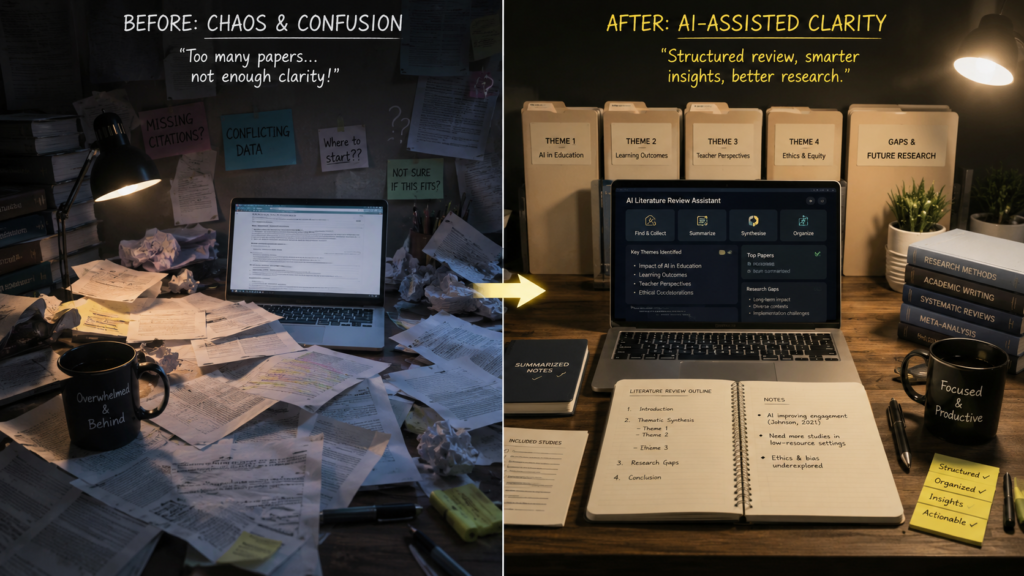
AI can significantly reduce the time required to complete a literature review, but only when students use it correctly. Many academic mistakes happen because students rely on AI too much instead of using it as a research assistant.
Even when using the Best AI Tools for Literature Review for Students, success still depends on critical thinking, careful reading, and ethical research practices.
Mistake 1 – Letting AI Replace Reading
AI summaries are useful, but they should never replace reading important research papers.
Always read the studies you plan to cite.
Mistake 2 – Accepting AI Responses Without Verification
AI occasionally misunderstands complex research or provides incomplete explanations.
Cross-check important claims with the original paper.
Mistake 3 – Using Fake or Incorrect Citations
Some AI assistants may generate inaccurate references if asked to create citations from memory.
Always verify:
• Author names
• Publication year
• Journal title
• DOI
• Page numbers
Mistake 4 – Ignoring Research Gaps
A literature review should explain what research is still missing—not just summarize existing studies.
Look for unanswered questions, limitations, and future research directions.
Mistake 5 – Organizing Papers Poorly
Downloading dozens of PDFs without a system quickly becomes confusing.
Use folders, tags, or citation managers from the beginning.
🚫 Myth vs ✅ Reality
Don’t let common misconceptions stop you from using AI effectively in academic research.
💡 Key Takeaway
AI is a powerful research assistant—not a replacement for critical thinking. Students who combine AI tools with careful reading, fact-checking, and proper citations produce stronger, more credible academic work.
Expert Tips for Better Literature Reviews

The Best AI Tools for Literature Review for Students work best when they support your academic judgment instead of replacing it.
Start With Research Questions
A clear research question makes it much easier to identify relevant papers.
Organize Research by Themes
Instead of reviewing papers one by one, group them by common ideas, methods, or findings.
Compare Before Writing
Look for similarities and differences across studies before drafting your literature review.
Verify Every Important Source
Never cite a paper you haven’t reviewed yourself.
Combine Multiple AI Tools
The strongest workflow uses specialized tools together.
For example:
• Semantic Scholar → discover papers
• Elicit → compare studies
• NotebookLM → summarize PDFs
• ChatGPT or Claude AI → organize themes
• Zotero → manage citations
Responsible AI Usage
Artificial intelligence should improve your productivity—not replace your academic responsibility.
Use AI to:
• Discover research papers
• Summarize complex studies
• Compare evidence
• Organize notes
• Plan your literature review
Avoid using AI to:
• Invent citations
• Fabricate research findings
• Copy AI-generated text directly into assignments
• Skip reading important papers
Universities increasingly encourage responsible AI use while expecting students to demonstrate original thinking and proper source evaluation.
Frequently Asked Questions
Students often have similar questions before choosing the Best AI Tools for Literature Review for Students, especially when balancing speed, accuracy, and academic integrity.
What is the best AI tool for literature reviews?
Elicit is one of the strongest options because it is specifically designed to help students analyze academic research and compare studies.
Can AI summarize research papers?
Yes. Tools such as NotebookLM, Claude AI, and ChatGPT can summarize research papers, although students should still read important sources themselves.
Which AI tool helps find research papers?
Semantic Scholar, ResearchRabbit, Consensus, and Elicit are excellent choices for discovering relevant academic literature.
Can AI identify research gaps?
AI can highlight patterns and missing areas across multiple studies, but students should confirm these gaps through careful reading.
Is AI allowed in university literature reviews?
Policies differ between institutions. Most universities allow AI as a research assistant but expect students to complete their own analysis and writing.
Can AI compare multiple research papers?
Yes. Elicit, Claude AI, and NotebookLM are particularly useful for comparing research findings and identifying recurring themes.
Does AI create accurate citations?
Citation managers like Zotero are more reliable for formatting references. Always verify AI-generated citations before submission.
Can AI replace literature reviews?
No. AI accelerates research tasks but cannot replace critical thinking, academic judgment, or original analysis.
Which free AI tool is best for students?
Many students start with ChatGPT Free, Semantic Scholar, ResearchRabbit, and Zotero because they provide significant value at no cost.
Should students rely completely on AI?
No. AI should support your workflow, while your understanding, evaluation, and interpretation remain the foundation of a strong literature review.
Continue Learning
If you’re building a complete AI-powered academic workflow, these related topics are worth exploring next:
📚 Continue Learning
Want to improve your AI-powered study workflow? Explore these carefully curated student guides from IndiaAITools.
Final Thoughts

Completing a literature review has never been easy.
Students must search for reliable research, compare multiple studies, identify patterns, organize evidence, and write a clear academic discussion—all while managing deadlines and other coursework.
The Best AI Tools for Literature Review for Students help simplify these challenges by reducing repetitive work and improving research organization.
However, the strongest literature reviews still depend on careful reading, thoughtful analysis, and ethical academic practices.
Use AI to discover papers faster, summarize complex research, compare evidence more efficiently, and organize your ideas—but let your own critical thinking shape the final review.
Students who combine responsible AI use with strong academic skills don’t just finish literature reviews faster—they produce better ones.
As AI continues to improve, the Best AI Tools for Literature Review for Students will become even more valuable for organizing evidence, identifying research gaps, and producing higher-quality academic work.