
Quick Answer
The Best AI Tools for Academic Research for Students help you discover research papers, understand complex studies, summarize PDFs, organize notes, manage citations, and build stronger research projects faster. Instead of replacing critical thinking, these AI tools reduce repetitive work so students can spend more time analyzing evidence and developing original ideas.
Introduction
Academic research is very different from doing homework.
It isn’t just about finding an answer.
It’s about finding reliable evidence.
Reading multiple sources.
Comparing different viewpoints.
Building logical arguments.
Citing trustworthy references.
And turning dozens of research papers into one organized project.
For many students, this process feels overwhelming.
You search Google.
Open twenty browser tabs.
Download fifteen PDFs.
Highlight hundreds of lines.
Then forget where you found that one important statistic.
Sound familiar?
Whether you’re writing your first research paper in high school or preparing a university capstone project, academic research can quickly become confusing without a clear system.
Fortunately, AI has changed the research process dramatically.
The Best AI Tools for Academic Research for Students don’t simply generate answers.
They help students:
• Find peer-reviewed research faster
• Understand difficult academic papers
• Summarize lengthy PDFs
• Organize research notes
• Build literature reviews
• Track citations
• Stay organized throughout an entire research project
The biggest advantage isn’t speed.
It’s clarity.
Instead of spending hours searching for information, students can spend more time understanding it.
This guide explains exactly how to build a smarter research workflow using AI while maintaining academic integrity and critical thinking.
The Best AI Tools for Academic Research for Students are becoming essential for students who want to save time while producing higher-quality research projects.
What Is Academic Research?

Academic research is the process of collecting, evaluating, and organizing trustworthy information to answer a research question or support an argument.
Unlike a normal Google search, academic research requires students to evaluate the quality of evidence before using it.
Most research projects include:
• Choosing a research topic
• Finding scholarly sources
• Reading journal articles
• Comparing evidence
• Taking organized notes
• Writing a literature review
• Citing references correctly
This process becomes more difficult as assignments become longer.
That is exactly where AI becomes valuable.
Learning how to use the Best AI Tools for Academic Research for Students can make even complex research assignments feel more organized and manageable.
Why Students Struggle With Academic Research

Research assignments often feel difficult because students are expected to manage several tasks at the same time.
Too Much Information
Searching one topic can produce thousands of results.
Students don’t know:
• Which source is trustworthy
• Which paper is outdated
• Which article is worth reading
Instead of making progress, they become overwhelmed.
Academic Papers Are Difficult to Read
Research papers are written for researchers.
Not beginners.
Many students spend twenty minutes reading a single page without understanding the main idea.
Organizing Sources
Research quickly becomes messy.
Students often save:
• PDFs
• Browser tabs
• Google Docs
• Screenshots
• Notes
After a few days, finding information becomes almost impossible.
Literature Reviews Feel Impossible
Many students know how to read one paper.
Very few know how to compare twenty papers together.
That’s why literature reviews are one of the biggest academic challenges.
Citation Management
Losing track of sources creates unnecessary stress.
Students often forget:
• Author names
• Publication years
• Journal titles
• DOI links
This creates extra work near the submission deadline.
Signs You’re Doing Academic Research the Hard Way
You may need a better research workflow if you regularly:
• Keep more than 20 browser tabs open.
• Download papers but never read them.
• Forget where important information came from.
• Read entire PDFs just to find one paragraph.
• Spend hours searching instead of analyzing.
• Struggle to compare different research studies.
• Lose track of citations.
• Feel overwhelmed before writing even begins.
If several of these sound familiar, your problem isn’t intelligence.
Your workflow needs improvement.
How AI Changes Academic Research
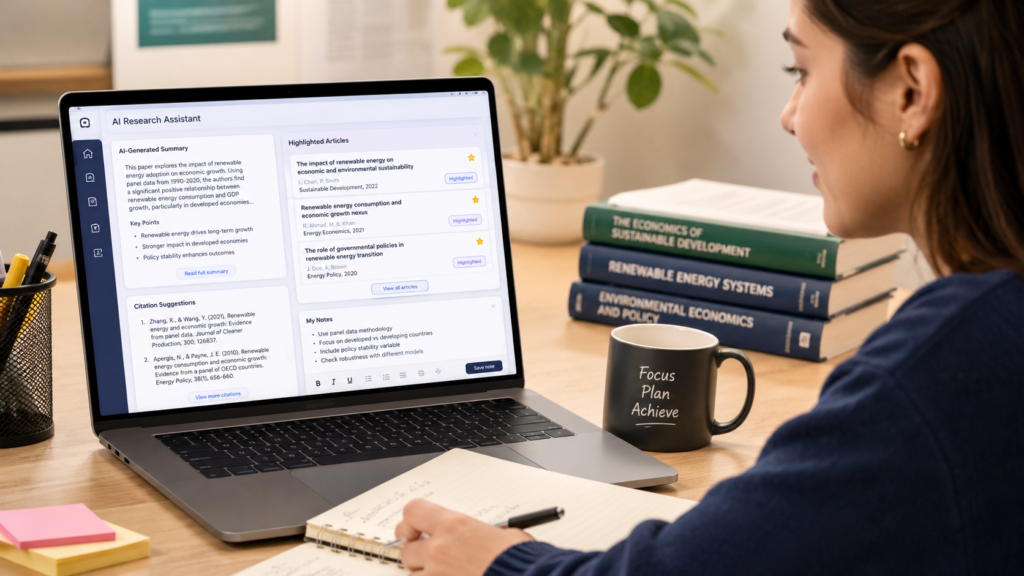
The biggest misconception is that AI simply writes papers.
Responsible students use AI very differently.
They use it to organize research.
Not replace it.
Faster Paper Discovery
Instead of scrolling through endless search results, AI-powered research tools help students discover relevant academic papers more efficiently by focusing on evidence-backed sources and related publications.
Smarter PDF Reading
Students no longer need to read every page from beginning to end.
Modern AI tools can:
• Explain difficult paragraphs
• Summarize key findings
• Highlight important methods
• Answer questions based only on uploaded research papers
NotebookLM (now being rebranded as Gemini Notebook) is widely recognized for helping students interact with their own research documents.
Better Literature Reviews
One of AI’s biggest strengths is comparing multiple studies.
Instead of manually switching between PDFs, students can identify:
• Similar conclusions
• Conflicting evidence
• Research gaps
• Common themes
Purpose-built academic tools like Elicit and Consensus are frequently recommended for literature review tasks.
Organized Research Notes
AI also helps students organize:
• Research summaries
• Quotes
• References
• Personal notes
• Study insights
Instead of dozens of scattered documents, everything stays in one structured system.
Instead of replacing researchers, the Best AI Tools for Academic Research for Students improve efficiency throughout every stage of the research process.
Real Student Scenario
How Sarah Finished Her Research Paper Without Feeling Overwhelmed
Sarah was a second-year university student preparing a research paper on artificial intelligence in healthcare.
Within two days, she had:
• 42 browser tabs
• 18 downloaded PDFs
• Multiple Google Docs
• Random screenshots
• No clear outline
Instead of continuing this chaotic workflow, she changed her process.
She used an AI-powered academic search tool to discover stronger research papers.
Then she uploaded the most relevant PDFs into a document-analysis tool to generate summaries and compare findings.
Finally, she organized her notes before writing her literature review.
Her paper still required critical thinking.
AI didn’t do the research for her.
It simply helped her organize it more efficiently.
Best AI Tools for Academic Research for Students

The Best AI Tools for Academic Research for Students are designed to simplify different stages of the research process.
Some tools help you discover research papers.
Others summarize complex studies.
Some organize citations, while others help build literature reviews.
The best results usually come from combining multiple AI tools instead of relying on just one.
Perplexity AI
Best For
Finding reliable information quickly with cited sources.
Key Features
• AI-powered research search engine
• Provides source citations
• Summarizes multiple sources
• Follow-up questions
• Web and academic search
Pros
• Very fast research
• Easy to verify information
• Excellent starting point for research
Cons
• Should not replace academic databases
• Some sources may not be peer-reviewed
Pricing
Free + Pro
Student Use Case
A college student beginning a research paper uses Perplexity to understand a new topic and identify reliable starting sources before searching academic journals.
Many students begin their research journey with the Best AI Tools for Academic Research for Students because they simplify the process of finding trustworthy information.
Consensus
Best For
Finding evidence from peer-reviewed research papers.
Key Features
• Searches academic publications
• AI-generated research summaries
• Evidence-based answers
• Peer-reviewed focus
Pros
• Excellent for university research
• Reliable scientific evidence
• Saves literature review time
Cons
• Best suited for academic topics
• Smaller database than Google Scholar
Pricing
Free + Premium
Student Use Case
A psychology student quickly finds studies supporting an argument instead of reading dozens of papers individually.
Elicit
Best For
Literature reviews and comparing research papers.
Key Features
• Literature review automation
• Research comparison
• Evidence extraction
• Research question analysis
Pros
• Huge time saver
• Excellent for graduate students
• Simplifies literature reviews
Cons
• Learning curve
• Advanced features require subscription
Pricing
Free + Paid
Student Use Case
An MBA student compares multiple business studies to identify research trends before writing a literature review.
NotebookLM (Google)
Best For
Understanding PDFs and research documents.
Key Features
• Upload PDFs
• AI summaries
• Ask questions about documents
• Source-based answers
• Research note organization
Pros
• Excellent for long papers
• Doesn’t hallucinate as much because it answers from uploaded sources
• Great learning companion
Cons
• Limited to uploaded documents
Pricing
Free
Student Use Case
A university student uploads ten research papers and asks NotebookLM to compare their conclusions.
Among the Best AI Tools for Academic Research for Students, NotebookLM stands out for helping students understand lengthy academic PDFs.
Semantic Scholar
Best For
Finding high-quality academic papers.
Key Features
• Millions of research papers
• Citation tracking
• Related paper recommendations
• AI-assisted discovery
Pros
• Trusted academic database
• Excellent filtering
• High-quality publications
Cons
• No complete AI writing assistant
Pricing
Free
Student Use Case
A science student searches for the latest peer-reviewed studies before beginning an assignment.
ResearchRabbit
Best For
Discovering related research papers.
Key Features
• Citation network visualization
• Research mapping
• Related paper recommendations
• Collection management
Pros
• Excellent for literature discovery
• Finds hidden research connections
Cons
• Better for advanced researchers
Pricing
Free
Student Use Case
A graduate student expands their literature review by discovering studies connected to one important research paper.
Zotero
Best For
Managing references and citations.
Key Features
• Citation manager
• Reference library
• Browser extension
• Automatic citation generation
• PDF organization
Pros
• Saves huge amounts of time
• Free
• Widely used by universities
Cons
• Doesn’t summarize research
Pricing
Free
Student Use Case
A student writing a dissertation automatically organizes hundreds of references without manually typing citations.
ChatGPT
Best For
Understanding complex topics and organizing research notes.
Key Features
• Explains difficult concepts
• Creates outlines
• Summarizes notes
• Brainstorms research questions
Pros
• Extremely versatile
• Easy to use
• Great research assistant
Cons
• Should never be used as the only research source
Pricing
Free + Paid
Student Use Case
A student asks ChatGPT to explain a difficult research paper in simple language before reading the original study.
Claude AI
Best For
Reading long research documents.
Key Features
• Long-context understanding
• PDF analysis
• Detailed summaries
• Logical explanations
Pros
• Excellent for lengthy papers
• Clear explanations
• Great organization
Cons
• Limited integrations
Pricing
Free + Paid
Student Use Case
A postgraduate student uploads a 120-page research report and asks Claude to summarize each chapter.
AI Research Tool Comparison Table
🔍 Perplexity
Free / Paid🎯 Best For: Quick research
✔ Strength: Fast source discovery
✘ Weakness: Not academic-only
🧠 Consensus
Free / Paid🎯 Best For: Peer-reviewed evidence
✔ Strength: Scientific answers
✘ Weakness: Limited scope
📚 Elicit
Free / Paid🎯 Best For: Literature reviews
✔ Strength: Research comparison
✘ Weakness: Learning curve
📄 NotebookLM
Free🎯 Best For: PDF analysis
✔ Strength: Source-based summaries
✘ Weakness: Upload required
🎓 Semantic Scholar
Free🎯 Best For: Research papers
✔ Strength: Academic database
✘ Weakness: No writing assistant
🐇 ResearchRabbit
Free🎯 Best For: Paper discovery
✔ Strength: Citation mapping
✘ Weakness: Advanced interface
📑 Zotero
Free🎯 Best For: Citation management
✔ Strength: Reference organization
✘ Weakness: No AI summaries
🤖 ChatGPT
Free / Paid🎯 Best For: Research planning
✔ Strength: Flexible assistant
✘ Weakness: Needs fact-checking
📝 Claude AI
Free / Paid🎯 Best For: Long document reading
✔ Strength: Excellent summaries
✘ Weakness: Fewer integrations
Comparing the Best AI Tools for Academic Research for Students helps students choose the right platform for discovering sources, reading papers, organizing notes, and managing citations more efficiently.
Traditional Research vs AI-Assisted Research
| Traditional Research | AI-Assisted Research |
|---|---|
| ❌ Manual Google searches | ✅ AI-powered research discovery |
| ❌ Read every paper completely | ✅ AI summaries first |
| ❌ Organize notes manually | ✅ AI note organization |
| ❌ Manual literature review | ✅ AI comparison of studies |
| ❌ Manual citations | ✅ Citation managers like Zotero |
| ❌ Hours finding papers | ✅ Minutes discovering relevant research |
Student Situation → Recommended AI Tool
📄 Finding Research Papers
Recommended Tool: Semantic Scholar ↗
📚 Understanding Difficult Papers
Recommended Tool: NotebookLM ↗
🔍 Literature Review
Recommended Tool: Elicit ↗
⚡ Quick Research
Recommended Tool: Perplexity ↗
📑 Organizing Citations
Recommended Tool: Zotero ↗
📖 Reading Long PDFs
Recommended Tool: Claude AI ↗
📝 Planning Research
Recommended Tool: ChatGPT ↗
🐇 Discovering Related Studies
Recommended Tool: ResearchRabbit ↗
Step-by-Step AI Academic Research Workflow
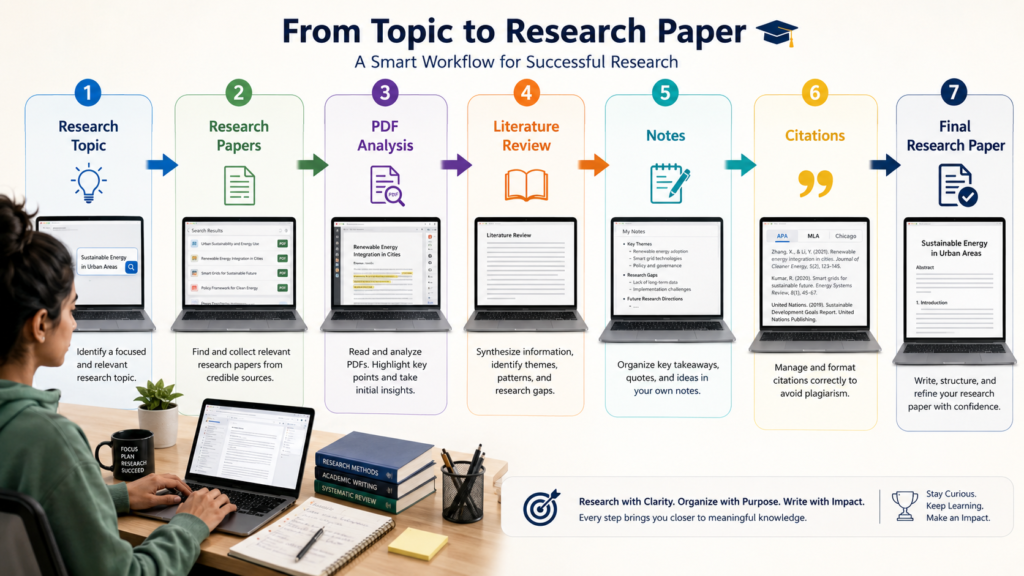
The Best AI Tools for Academic Research for Students work best when they are used as part of a structured workflow—not as shortcuts.
Follow this research process to stay organized and improve the quality of your academic work.
Choose Research Topic
↓
Generate Research Questions
↓
Discover Research Papers
↓
Read & Summarize PDFs
↓
Compare Multiple Studies
↓
Take Organized Notes
↓
Build Literature Review
↓
Create Citations
↓
Write Research Paper
↓
Final Review
Each stage has a different purpose, and using the right AI tool at the right time makes the entire research process more efficient.
Following the Best AI Tools for Academic Research for Students workflow reduces confusion and helps students stay organized from start to finish.
7-Step AI Research Plan
Step 1 – Choose a Research Topic
If you’re unsure what to research, ask AI to suggest focused and manageable topics.
Example Prompt:
“Suggest ten research topics about artificial intelligence in education that are suitable for a university research paper.”
Step 2 – Discover Reliable Research Papers
Instead of searching randomly, use:
• Semantic Scholar
• Consensus
• Perplexity
• Research
RabbitLook for:
• Recent publications
• Peer-reviewed journals
• Highly cited papers
• Credible authors
Step 3 – Read Smarter, Not Harder
Upload important PDFs into NotebookLM or Claude AI.
Ask questions like:
• What is the main argument?
• What methodology was used?
• What are the key findings?
• What limitations did the authors mention?
This helps you understand papers before reading them in full.
Step 4 – Compare Multiple Studies
Literature reviews are not summaries of individual papers.
They compare patterns across several studies.
AI can help identify:
• Similar findings
• Contradictory evidence
• Research gaps
• Frequently cited theories
Step 5 – Organize Research Notes
Keep separate sections for:
• Important quotesKey statistics
• Personal observations
• Research questions
• Future references
Organization now saves hours later.
Step 6 – Manage Citations
Never wait until the final day.
Use Zotero to organize:
• Authors
• Journal names
• Publication years
• DOIs
• Citation styles
Step 7 – Begin Writing
Only after understanding your research should you begin writing.
AI should help you:
• Organize ideas
• Improve clarity
• Structure arguments
It should never replace your own analysis.
Best AI Prompts for Academic Research
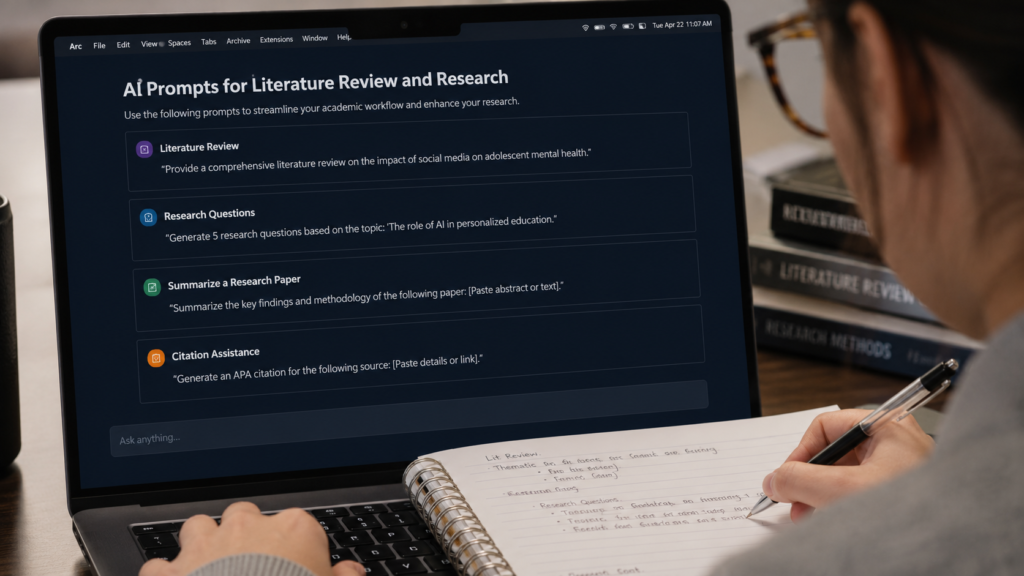
Find Research Questions
“Generate ten original research questions about renewable energy adoption.”
Literature Review
“Compare these five research papers and summarize their common findings.”
Understand a PDF
“Explain this research paper in simple language suitable for a college student.”
Research Gap
“Identify possible research gaps based on these published studies.”
Summarize Findings
“Summarize the key findings from these journal articles in bullet points.”
Compare Evidence
“Compare the arguments presented in these two academic papers.”
Organize Notes
“Turn these research notes into organized sections for a literature review.”
Improve Research Outline
“Review my research outline and recommend a better logical structure.”
Generate Keywords
“Suggest academic search keywords related to my research topic.”
Prepare for Writing
“Help me organize this research into a structured academic paper.”
Common Mistakes Students Make During Academic Research
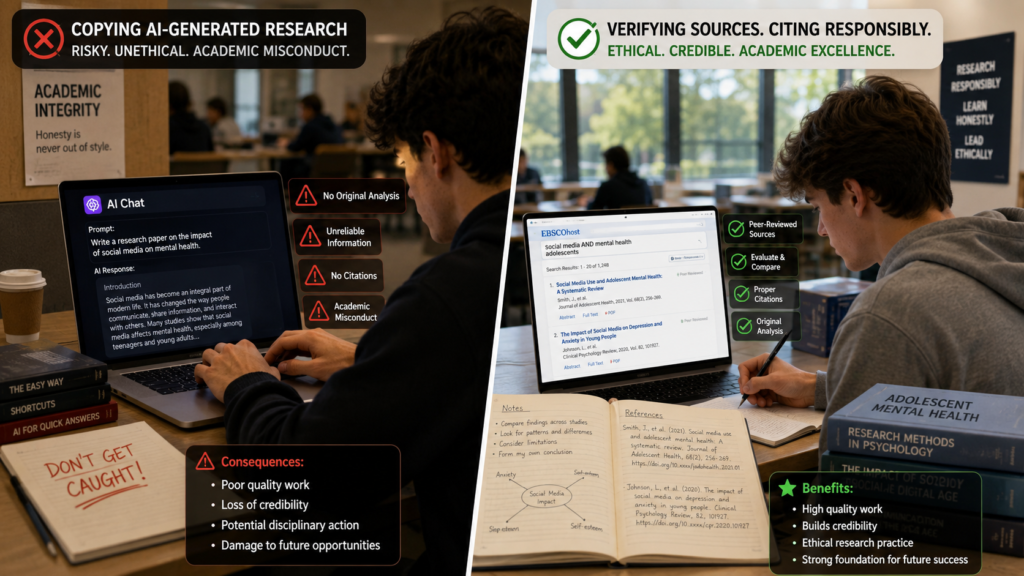
Using AI Instead of Reading Papers
AI summaries save time.
They should never replace reading important research yourself.
Trusting Every AI Response
Always verify:
• Statistics
• Dates
• Author names
• Citations
Ignoring Peer-Reviewed Sources
Wikipedia and blogs are useful for understanding topics.
Research papers should rely on academic sources whenever possible.
Poor Organization
Many students save dozens of PDFs without organizing them.
Use folders, collections, and citation managers.
Waiting Until the Deadline
Good research takes time.
Start early and work consistently.
Even the Best AI Tools for Academic Research for Students cannot replace careful reading, fact-checking, and independent analysis.
Responsible AI Use in Academic Research
AI should support learning—not replace it.
Use AI to:
• Discover sources
• Understand difficult concepts
• Organize notes
• Compare studies
• Build research workflows
Avoid using AI to:
• Fabricate citations
• Invent research findings
• Submit AI-generated research papers
• Misrepresent academic work
Responsible AI use builds stronger researchers.
Students gain the most value from the Best AI Tools for Academic Research for Students when they use AI as a research assistant rather than a replacement for learning.
Myth vs Reality
❌ MYTH
AI can replace academic research.
✅ REALITY
AI supports research, but cannot replace critical thinking.
❌ MYTH
AI always provides correct citations.
✅ REALITY
Students should verify every reference before using it.
❌ MYTH
Reading papers is unnecessary.
✅ REALITY
AI summaries improve understanding, but original research papers still matter.
❌ MYTH
One AI tool does everything.
✅ REALITY
Different AI tools solve different research problems.
❌ MYTH
AI guarantees better grades.
✅ REALITY
Strong research still depends on analysis, reliable evidence, and original thinking.
Frequently Asked Questions
❓ What is the best AI tool for academic research?
There isn’t a single best tool. Perplexity, Consensus, NotebookLM, Elicit, Semantic Scholar, and ChatGPT each solve different research tasks.
❓ Can AI summarize research papers?
Yes. NotebookLM, Claude AI, and ChatGPT can summarize research papers, but students should still review the original source.
❓ Is AI allowed in university research?
Many universities allow AI for brainstorming, organization, and summarization, but policies vary. Always follow your instructor’s guidelines.
❓ Can AI perform literature reviews?
AI can assist with literature reviews by comparing studies and identifying themes, but students should verify conclusions independently.
❓ Which AI tool is best for finding research papers?
Semantic Scholar, Consensus, and ResearchRabbit are excellent options for discovering reliable academic papers.
❓ Can AI generate citations?
Yes, but students should always verify citation accuracy using Zotero or official citation guides before submission.
❓ Should students trust AI-generated research?
AI should be treated as an assistant, not an authority. Always verify important information using reliable academic sources.
❓ Can AI help international students with research?
Yes. AI can simplify difficult academic language, summarize complex papers, and improve research organization.
❓ Is Google enough for academic research?
Google is a useful starting point, but academic databases like Semantic Scholar provide more reliable scholarly sources.
❓ Which AI tool should beginners start with?
A great beginner combination is Perplexity for research discovery, NotebookLM for reading PDFs, and ChatGPT for planning research projects.
Key Takeaways
• Academic research is about finding and evaluating reliable evidence—not just searching online.
• Different AI tools solve different research problems.
• Use AI to discover, organize, and understand information.
• Verify all important facts and citations.
• Critical thinking remains your greatest research skill.
The Best AI Tools for Academic Research for Students deliver the best results when they are combined with reliable academic sources, careful analysis, and your own original thinking.
Continue Learning
Expand your AI study workflow with these guides:
📚 Continue Learning
Want to study smarter with AI? Explore these hand-picked guides to improve your productivity, writing, note-taking, homework, and exam preparation.
Manage multiple assignments faster with AI-powered study tools.
📂 Recover From Homework BacklogsLearn how AI helps you catch up on overdue homework efficiently.
⏰ Last-Minute Exam PreparationDiscover AI tools that help you prepare quickly before exams.
✍️ Start Essays Faster With AIBeat writer’s block and generate better essay ideas.
📖 Review Long Chapters QuicklySummarize long chapters and revise faster using AI.
🃏 Create AI Study FlashcardsTurn your notes into interactive flashcards in minutes.
📒 Organize Messy Class NotesClean, organize, and improve your class notes using AI.
🎤 Automatic Lecture NotesCapture lectures automatically and create smart notes instantly.
Final Verdict

Choosing the Best AI Tools for Academic Research for Students is less about finding one perfect platform and more about building a complete research workflow that matches your academic needs.
Academic research doesn’t have to feel overwhelming.
The Best AI Tools for Academic Research for Students can help you discover reliable sources, understand complex research papers, organize notes, compare evidence, and manage citations more efficiently.
The goal isn’t to let AI think for you.
The goal is to remove repetitive tasks so you can spend more time analyzing evidence, developing original ideas, and producing higher-quality academic work.
Students who use AI responsibly won’t just finish research projects faster—they’ll become better researchers in the process.