Last Updated: May 2026
Quick Answer
The best AI tools to improve weak English writing for students help with grammar correction, essay organization, brainstorming, proofreading, and writing confidence. Tools like ChatGPT, Grammarly, QuillBot, Claude AI, and Google Gemini can help students improve sentence clarity, reduce procrastination, and write faster when used responsibly as learning assistants instead of full replacements for thinking.
Introduction
It is 11:38 PM.
Your English assignment is due tomorrow morning.
You open Google Docs, type one sentence, delete it, rewrite the same line three times, then suddenly start checking YouTube because your brain feels completely stuck.
Most students know this feeling.
Sometimes the problem is not laziness.
Sometimes your ideas are actually good, but your English writing confidence is weak.
You know what you want to say.
You just cannot make the sentences sound right.
That is why more students are searching for the best AI tools to improve weak English writing for students.
Not because they want AI to secretly write essays for them.
But because they want help with:
• grammar mistakes
• awkward wording
• essay organization
• writer’s block
• assignment stress
• low confidence
This is where things get difficult.
A lot of students use AI the wrong way.
They copy robotic paragraphs directly, use vocabulary they would never normally say, and then panic because the essay suddenly does not sound human anymore.
But smart students use AI differently.
They use it to:
• organize thoughts
• improve clarity
• rewrite awkward sentences
• build outlines
• understand grammar faster
• reduce homework overwhelm
This guide explains how students can use AI tools practically, ethically, and realistically without sounding robotic or AI-generated.
Who This Guide Is For
This guide is for students who:
• struggle with grammar confidence
• feel nervous writing essays
• rewrite introductions repeatedly
• understand ideas but cannot express them clearly
• panic during writing assignments
• feel overwhelmed by English homework
• want writing help without cheating
It is especially useful for:
• high school students
• beginner writers
• ESL learners
• shy students with weak writing confidence
• students afraid teachers will detect AI writing
The best AI tools to improve weak English writing for students work best when students need support, structure, and confidence — not shortcuts.
Signs Your English Writing Needs Improvement
A lot of students do not realize their main problem is clarity, not intelligence.
Common signs include:
• awkward sentence flow
• repetitive wording
• weak introductions
• confusing paragraphs
• grammar insecurity
• essays sounding robotic
• struggling to explain ideas clearly
Most students do this.
They try to sound “smart” by using complicated vocabulary.
But the result usually sounds unnatural.
Clear writing almost always sounds better than forced advanced writing.
Why Students Struggle With Weak English Writing

Writing pressure affects students emotionally more than people realize.
Especially during stressful school weeks.
Procrastination
Students delay essays because starting feels uncomfortable.
The assignment sits untouched for days.
Then suddenly it becomes a midnight emergency.
The best AI tools to improve weak English writing for students help reduce this pressure by making the first step easier.
Weak Confidence
Some students have strong ideas but weak confidence.
They constantly wonder:
• “Does this sentence sound wrong?”
• “What if my grammar is bad?”
• “What if my teacher thinks I used AI?”
That fear slows everything down.
Perfectionism
Students often spend 40 minutes rewriting one paragraph instead of finishing the essay.
Perfectionism quietly creates procrastination.
Poor Organization
Sometimes students understand the topic but cannot organize thoughts logically.
The essay becomes:
• repetitive
• messy
• difficult to follow
AI outlining tools help students create structure faster.
Burnout and Time Pressure
Exam week creates chaos.
Students manage:
• homework
• quizzes
• projects
• sports
• revision
• stress
Even simple writing tasks start feeling exhausting.
How AI Tools Can Actually Help Students
The best AI tools to improve weak English writing for students are helpful because they reduce friction during writing.
But this is important.
AI should support learning — not replace thinking completely.
AI as a Brainstorming Helper
Students staring at blank documents often just need momentum.
AI can generate:
• topic ideas
• thesis directions
• outline suggestions
• paragraph structures
That makes starting easier.
AI as Grammar Support
Many students lose confidence because of grammar mistakes.
AI tools help fix:
• awkward wording
• sentence clarity
• punctuation
• repetitive phrasing
This creates faster feedback loops.
AI as an Organizer
AI helps students structure essays logically instead of randomly writing ideas.
That improves readability immediately.
AI as a Confidence Booster
Students with weak English writing often panic because they think every sentence sounds bad.
AI tools reduce that anxiety by helping students revise more efficiently.
Step-by-Step Student Workflow
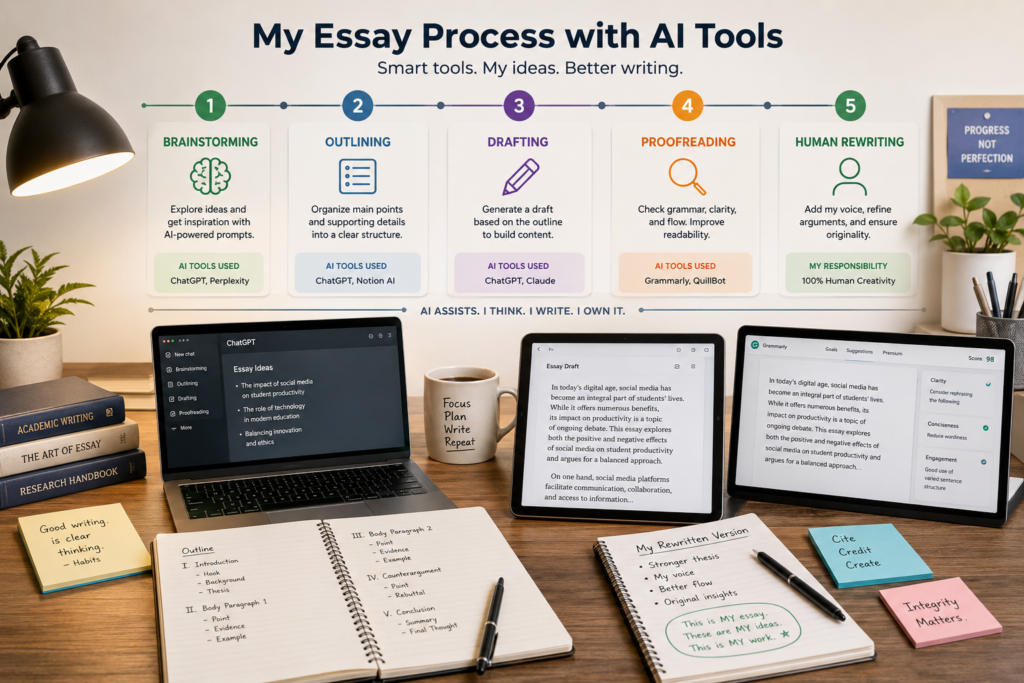
The best AI tools to improve weak English writing for students work best when students follow a clear system instead of using AI randomly.
Here is a realistic workflow.
Step 1: Brainstorming
Start by asking AI broad questions.
Examples:
• “Give me three essay ideas about social media and teenagers.”
• “Help me brainstorm arguments for school uniforms.”
• “Explain this topic simply before I start writing.”
This helps students overcome blank-page anxiety.
Step 2: Outlining
Use AI to build basic essay structure:
• introduction
• thesis
• body paragraphs
• supporting examples
• conclusion
This prevents essays from feeling scattered.
Step 3: Scheduling
Students constantly underestimate essay time.
Better approach:
• 20 minutes brainstorming
• 30 minutes outlining
• 1 hour drafting
• 20 minutes proofreading
• 15 minutes human revision
Tools like Todoist and Notion help students stay organized.
Step 4: Drafting
Write naturally.
Do not paste AI paragraphs directly.
Instead:
• simplify suggestions
• rewrite awkward phrases
• use your own wording
• add personal rhythm
Step 5: Revising
Ask AI questions like:
• “Does this paragraph sound repetitive?”
• “How can I improve this transition?”
• “Can you simplify this sentence?”
This improves clarity without removing student voice.
Step 6: Proofreading
Students often skip proofreading because deadlines feel stressful.
But proofreading catches:
• grammar mistakes
• repeated words
• awkward transitions
• punctuation errors
Step 7: Final Humanization
This is where many students fail.
Before submitting:
• remove robotic vocabulary
• shorten overly formal sentences
• add natural phrasing
• rewrite stiff transitions
A slightly imperfect human sentence usually sounds more authentic than perfect AI wording.
Realistic Assignment Night Timeline
Example workflow:
• 9:00 PM → brainstorming
• 9:20 PM → outline creation
• 10:00 PM → drafting
• 11:00 PM → proofreading
• 11:20 PM → final human rewrite
This feels far more manageable than trying to “write the perfect essay” all at once.
Daily 15-Minute English Improvement System
Students do not always need massive study sessions.
Small consistent improvement matters more.
The best AI tools to improve weak English writing for students become far more effective when students use them consistently for small daily writing improvement instead of only during deadline panic.
Simple routine:
5 Minutes Reading
Read one short article or paragraph.
Notice:
• sentence flow
• transitions
• vocabulary
5 Minutes Rewriting
Rewrite awkward sentences naturally.
QuillBot and ChatGPT help here.
5 Minutes Grammar Fixing
Use Grammarly or AI grammar tools to identify mistakes and understand corrections.
Over time, students naturally improve writing confidence.
Best AI Tools for Students
ChatGPT
Brainstorming, outlining, essay structure, and explanations.
A student stuck on essay introductions asks ChatGPT for three opening ideas to reduce blank-page anxiety.
Grammarly
A student proofreading an essay before midnight uses Grammarly to catch punctuation mistakes and awkward phrasing.
QuillBot
A student rewrites robotic AI paragraphs into more natural student language.
Claude AI
A student asks Claude AI to explain why a paragraph feels repetitive.
Google Gemini
Free vs Paid AI Tools — What Students Actually Need
Most high school students do not need expensive subscriptions immediately.
Free versions are often enough for:
• brainstorming
• proofreading
• outlining
• basic grammar correction
Paid plans become useful when students need:
• advanced revisions
• heavy daily usage
• detailed writing feedback
• larger assignments
But honestly, most beginner students can improve significantly using free tools responsibly.
Many students searching for the best AI tools to improve weak English writing for students do not actually need expensive subscriptions at the beginning because free AI writing support tools already provide enough help for grammar, outlining, and clarity improvement.
Comparison Table
| AI Tool | Best For | Grammar & Clarity | Rewriting | Writing Feedback | Best Student Use |
|---|---|---|---|---|---|
| ChatGPT | Writing feedback & revision | Draft improvement | |||
| Grammarly | Grammar & clarity | Proofreading | |||
| QuillBot | Rewriting & paraphrasing | Sentence improvement | |||
| Claude | Detailed revision | Long-form writing | |||
| Google Gemini | Writing help & brainstorming | Ideas + revision |
Before vs After Examples

Weak Writing Example
“Social media is bad because teenagers use phones too much and it affects them negatively.”
Problem:
• vague
• repetitive
• weak explanation
Robotic AI Example
“The excessive utilization of social networking platforms has substantially impacted adolescent psychological behavior patterns.”
Problem:
• unnatural wording
• unrealistic vocabulary
• robotic tone
Improved Human Version
“Social media affects many teenagers because constant scrolling can increase stress, reduce focus, and make real-life communication harder.”
Why this works:
• sounds natural
• clear and readable
• realistic student voice
• stronger clarity
How to Use AI Without Losing Your Own Voice
How Students Accidentally Sound AI-Generated
Students often sound AI-generated without realizing it.
Common signs include:
• advanced vocabulary overload
• emotionless writing
• robotic sentence rhythm
• repetitive transitions
• overly polished wording
Teachers notice this quickly.
Especially when vocabulary suddenly changes dramatically.
How to Make AI Writing Sound More Human
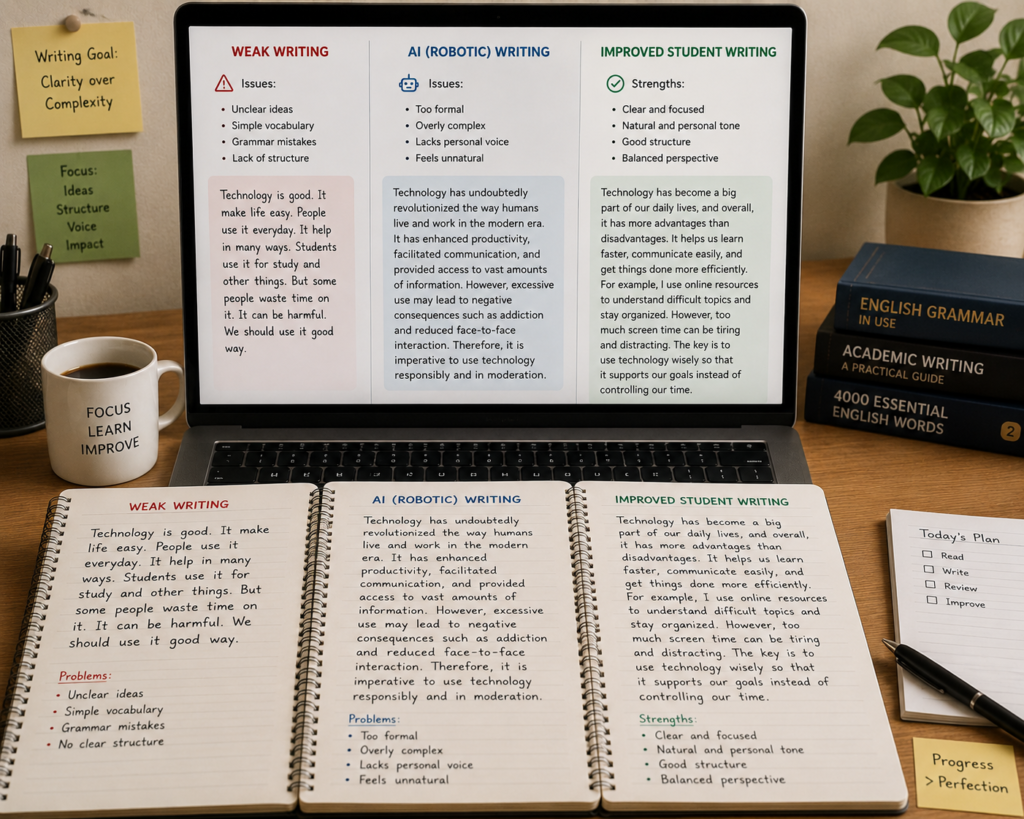
The best AI tools to improve weak English writing for students still require human editing.
Simplify Robotic Language
Replace:
• “utilize” → “use”
• “facilitate” → “help”
• “substantial” → “important”
Simple language sounds more natural.
Add Personal Voice
Students should rewrite AI wording closer to their natural speaking rhythm.
Mix Sentence Lengths
Human writing naturally varies.
Short sentences create rhythm.
Use Realistic Examples
Specific examples make writing sound human instead of generic.
What AI Still Cannot Do Well
AI still struggles with:
• authentic emotions
• real classroom experiences
• personal observations
• genuine storytelling
• unique human perspective
That human layer still matters.
Common Mistakes Students Make With AI
Copying AI Directly
Teachers often recognize robotic essays immediately.
Trusting AI Blindly
AI sometimes creates:
• fake facts
• fake citations
• weak explanations
Always verify information.
Skipping Proofreading
Even AI-assisted essays need human review.
Overusing Advanced Vocabulary
Complicated wording often sounds fake instead of intelligent.
How to Use AI Without Cheating
The best AI tools to improve weak English writing for students should support learning — not replace learning completely.
Understand → Revise → Write Workflow
Understand
Use AI to learn concepts.
Revise
Analyze suggestions carefully.
Write
Rewrite ideas naturally in your own voice.
Originality Still Matters
Teachers want student thinking — not copied AI paragraphs.
What Teachers Actually Notice
Teachers often notice:
• sudden vocabulary jumps
• robotic tone
• emotionless paragraphs
• inconsistent writing quality
• unnatural phrasing
Human editing helps prevent this.
Real-Life Student Example
Maria, a high school student, struggled with English essays because her grammar confidence was weak.
During exam week she had:
• a history essay
• science homework
• SAT preparation
• multiple deadlines
She kept rewriting the introduction repeatedly because nothing sounded “smart enough.”
Eventually she used ChatGPT for brainstorming, Grammarly for proofreading, and QuillBot for simplifying awkward sentences.
At first she copied AI wording directly.
But the essay sounded robotic.
So she rewrote everything naturally in simpler language.
Final result:
• faster writing
• fewer grammar mistakes
• stronger confidence
• less procrastination
Most importantly, the essay still sounded like her.
Fastest Improvements Students Usually Notice
Students using the best AI tools to improve weak English writing for students often notice:
• fewer grammar mistakes
• faster essay writing
• clearer sentence structure
• lower stress
• better organization
• improved writing confidence
Consistency matters more than perfection.
Best ChatGPT Prompts Students Can Use
Brainstorming Prompt
“Give me three essay topic ideas about technology and teenagers.”
Outline Prompt
“Create a simple five-paragraph outline for this topic.”
Grammar Improvement Prompt
“Fix grammar mistakes while keeping my writing style natural.”
Humanization Prompt
“Rewrite this paragraph in simpler student language.”
Thesis Statement Prompt
“Help me improve this thesis statement without sounding robotic.”
Proofreading Prompt
“Check this paragraph for awkward wording and clarity issues.”
Study Scheduling Prompt
“Help me create a 2-hour homework plan for tonight.”
Conclusion
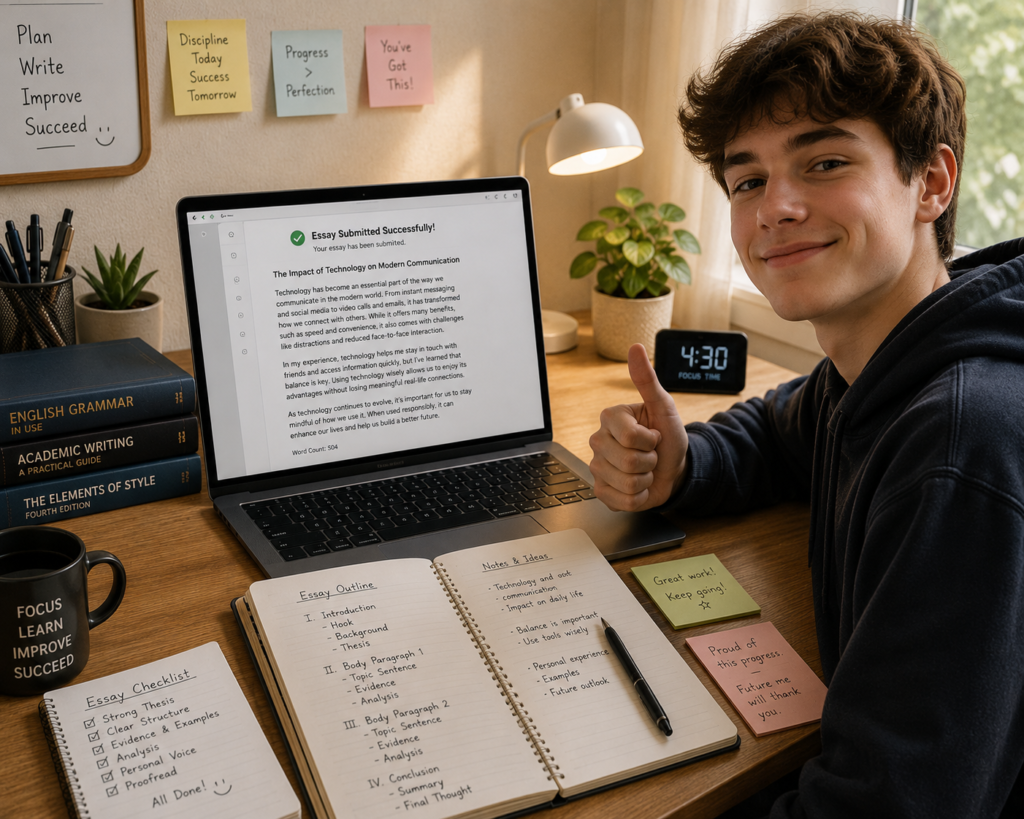
Weak English writing does not mean a student is unintelligent.
A lot of students struggle with:
• confidence
• grammar
• organization
• procrastination
• assignment pressure
The best AI tools to improve weak English writing for students help reduce that pressure by making writing more manageable.
They help students:
• brainstorm faster
• organize essays
• improve grammar
• reduce overwhelm
• build confidence
Students looking for more essay-focused AI writing help can also explore our guide on Best AI Tools to Help High School Students Write Better Essays (2026) for practical workflows, proofreading systems, and student-friendly writing strategies.
But this is important.
AI should support your thinking — not replace it.
Students who struggle with essay structure may also find our guide on How to Use ChatGPT to Outline an Essay Without Sounding AI-Generated helpful for learning how to organize ideas naturally without creating robotic essays.
Students who combine AI support with genuine effort usually improve much faster because they spend less time panicking and more time practicing.
Students interested in productivity systems may also benefit from guides about AI homework tools, AI essay outlining systems, and AI study planners for managing assignments more efficiently.
A strong assignment is not about sounding like AI. It is about sounding clear, thoughtful, organized, and genuinely human.
continue learning
Continue Learning
Explore these related IndiaAITools guides for more practical help with AI-assisted student writing.
frequently asked question
Here are answers to common questions students may have about using AI tools to improve English writing, grammar, clarity, and revision skills.
Can AI tools help students improve weak English writing?
Yes. AI writing tools can help students identify grammar errors, improve sentence clarity, expand vocabulary, adjust tone, and organize ideas. They work best as writing assistants rather than replacements for the student’s own thinking and writing.
Which AI tool is best for improving English writing?
There is no single best tool for every student. Grammarly is useful for grammar and clarity, QuillBot can help with rewriting and paraphrasing, while ChatGPT, Claude, and Gemini can provide broader writing feedback and explanations. The right choice depends on the type of writing help you need.
Can ChatGPT improve my English writing?
Yes. Students can use ChatGPT to identify unclear sentences, explain grammar mistakes, suggest clearer wording, and provide feedback on drafts. It is better to ask for explanations and suggestions rather than simply replacing the entire piece of writing.
Can AI correct grammar mistakes in an essay?
Yes. AI writing tools can identify many common grammar, spelling, punctuation, and sentence-structure problems. However, students should review the suggested corrections because AI tools can sometimes change the intended meaning or make an unsuitable suggestion.
Can AI make student writing sound more natural?
Yes. AI can suggest clearer wording, smoother transitions, and more natural sentence structures. Students should still preserve their own voice and make the final decisions about how their writing sounds.
Can teachers detect AI-written student essays?
AI detection tools are not perfectly reliable, and no detector should be treated as definitive proof that a piece of writing was created by AI. Students should follow their school’s or instructor’s AI-use policy and submit work that reflects their own understanding and permitted use of AI.
Is it okay for students to use AI to improve their writing?
It can be, depending on the rules of the student’s school, college, or instructor. Using AI for grammar feedback, explanations, brainstorming, or revision may be permitted in some settings, while submitting AI-generated work as your own may violate academic-integrity rules. Always check the applicable policy.
How should students use AI to improve English writing without becoming dependent on it?
Use AI as a feedback and learning tool. Write your own draft first, ask AI to identify specific problems, review the explanations, make your own revisions, and then proofread the final version yourself. This helps build writing skills instead of simply outsourcing the writing.