Quick Answer
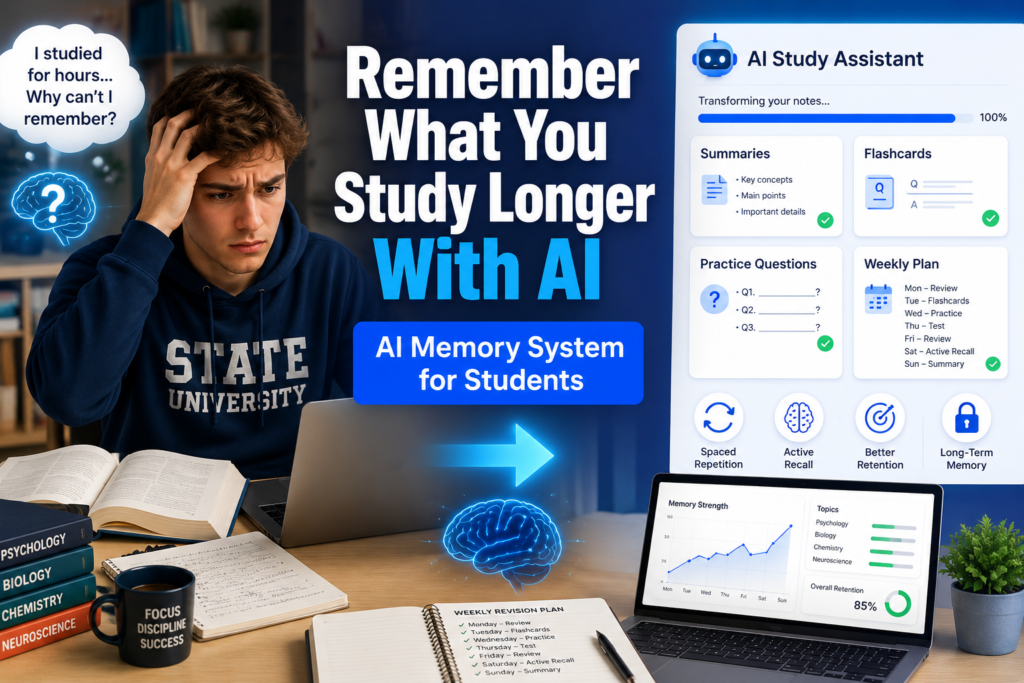
Many students spend hours studying but struggle to remember what they learned just a few days later. The problem usually isn’t a lack of effort—it’s using study methods that don’t help the brain store information for the long term.
Learning how to use AI tools to remember what you study longer isn’t about letting AI do the work for you. It’s about using AI to create better summaries, explain difficult concepts, generate flashcards, build practice questions, and plan revision sessions that improve memory retention.
When combined with proven techniques like active recall and spaced repetition, AI can help students study smarter, reduce forgetting, and prepare for exams with greater confidence.
How to Use AI Tools to Remember What You Study Longer is one of the most practical study strategies for students who want to improve memory retention without spending extra hours studying.
Introduction
Have you ever finished studying an entire chapter, felt confident, and then realized two days later that you could barely remember anything?
You’re not alone.
This is one of the biggest frustrations students face.
Some students believe they have a “bad memory.”
Others think they simply aren’t studying long enough.
In reality, the problem is often much simpler.
Most students spend their study sessions reading, highlighting, or copying notes instead of actively using the information they just learned.
Your brain doesn’t remember information because you looked at it several times.
It remembers information because you repeatedly retrieve, apply, and review it over time.
This is where AI can become a valuable study partner.
Instead of replacing your learning, AI can help organize information, simplify difficult topics, generate personalized practice questions, create flashcards, and remind you exactly when to review what you’ve learned.
By the end of this guide, you’ll have a complete AI-powered memory retention system that helps you remember what you study longer—not just until tomorrow’s quiz, but well beyond your exams.
This guide explains How to Use AI Tools to Remember What You Study Longer through a complete study system that combines AI with active recall, flashcards, and spaced repetition.
Why Students Forget What They Study
Forgetting is completely normal.
The human brain constantly decides what information is worth keeping and what information can be discarded.
If information isn’t used again, your brain assumes it isn’t important.
Understanding why this happens makes it much easier to fix.
The Forgetting Curve
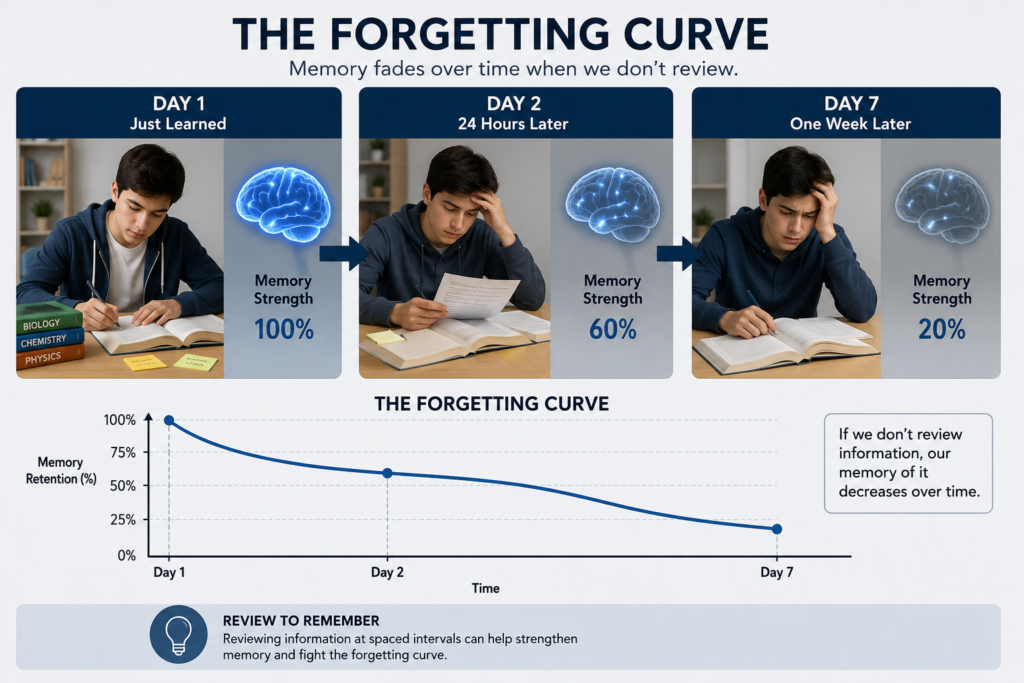
After learning something new, memory begins to fade surprisingly quickly.
Without revision, much of the information can disappear within a few days.
That doesn’t mean you failed to learn.
It simply means your brain never received enough reminders to keep that knowledge active.
Regular review interrupts this forgetting process and strengthens long-term memory.
Students interested in the science behind memory can also explore research from the American Psychological Association (APA).
Passive Reading
Reading a chapter three times often feels productive.
Unfortunately, it creates an illusion of learning.
Many students recognize information while reading but cannot explain it without looking at the page.
Recognition is not the same as remembering.
Your brain learns much more effectively when you try to recall information without seeing your notes.
Lack of Active Recall
Imagine someone asks you to explain a biology process without opening your textbook.
If you struggle, you’ve discovered an area that needs reinforcement.
This simple act of retrieving information is called active recall, and it’s one of the most effective ways to improve memory.
AI can generate unlimited recall questions, making this process easier than ever.
No Revision Schedule
Many students review only once—right before an exam.
Unfortunately, last-minute cramming may help short-term recall, but much of that information disappears soon afterward.
Small review sessions spread across several days are usually much more effective than one long revision session.
Information Overload
Trying to memorize an entire 40-page chapter in one evening overwhelms the brain.
Important ideas become buried under unnecessary details.
Breaking chapters into smaller sections makes studying far more manageable.
AI helps by identifying key concepts and creating organized summaries that reduce cognitive overload.
Understanding why memory fades is the first step in learning How to Use AI Tools to Remember What You Study Longer.
Can AI Really Help You Remember What You Study?
The short answer is yes—but not in the way many students expect.
AI cannot magically upload knowledge into your brain.
You still need to read, think, solve problems, and practice.
What AI does exceptionally well is making those activities more efficient.
For example, instead of spending an hour rewriting notes, AI can summarize a chapter in minutes.
Instead of wondering what to revise next, AI can identify key concepts and generate personalized questions based on your study material.
Instead of creating flashcards manually, AI can produce them automatically so you can spend more time reviewing and less time organizing.
However, AI also has limitations.
It can misunderstand context, oversimplify complex topics, or occasionally generate inaccurate information.
That’s why students should always compare AI-generated material with textbooks, lecture notes, and instructor guidance.
Think of AI as a study assistant—not a replacement for your own understanding.
Students who treat AI as a partner usually benefit far more than those who expect it to do all the learning for them.
Students who understand How to Use AI Tools to Remember What You Study Longer often spend less time rereading notes and more time practicing active learning.
How AI Improves Memory Retention
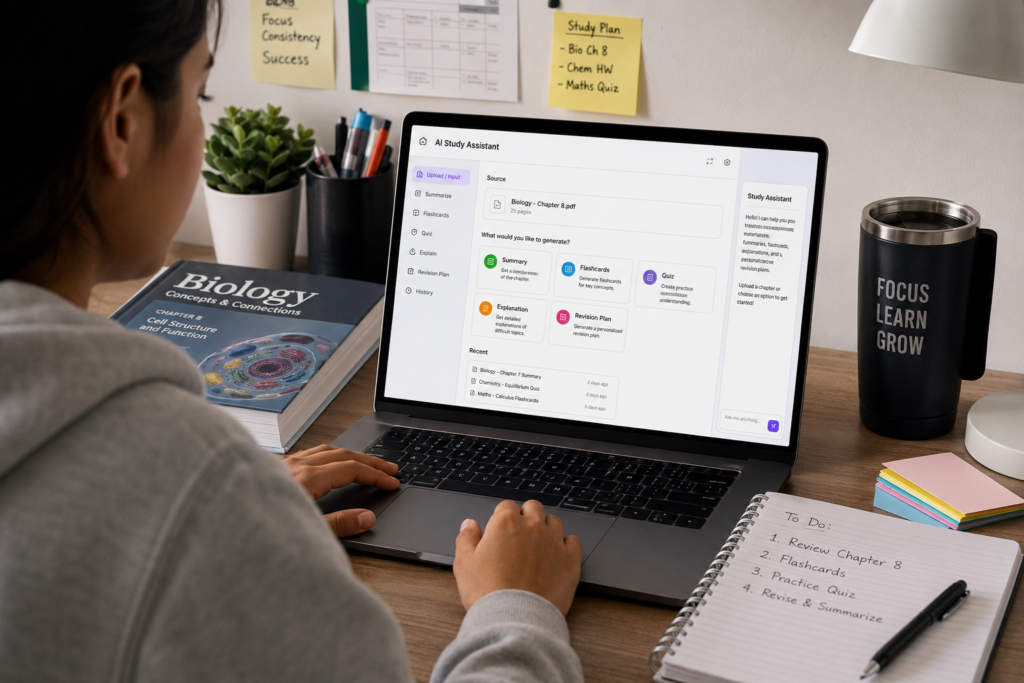
AI doesn’t improve memory by itself.
It improves the way students interact with information.
Instead of reading passively, students begin solving problems, answering questions, reviewing summaries, and revisiting weak topics more consistently.
Learning How to Use AI Tools to Remember What You Study Longer starts with using AI to improve understanding instead of simply reading more.
AI Summaries
Large textbook chapters often contain far more detail than students need during revision.
AI can organize those chapters into shorter summaries that highlight the most important concepts while keeping the overall structure easy to follow.
This reduces study time without eliminating essential information.
AI Explanations
Sometimes forgetting happens because the original explanation never made sense.
AI can explain the same concept using simpler language, practical examples, or step-by-step reasoning.
When students truly understand an idea, remembering it becomes much easier.
Personalized Learning
Every student struggles with different topics.
AI can adjust explanations, generate custom quizzes, or recommend additional review based on individual weaknesses rather than forcing everyone to study the same way.
AI-Generated Flashcards
One of the biggest reasons students forget information is that they rarely test themselves after studying.
Reading the same chapter again feels productive, but it doesn’t force your brain to retrieve information.
Flashcards solve this problem.
Instead of seeing the answer immediately, you first try to remember it yourself.
That small mental effort strengthens memory far more than passive reading.
AI makes this process much easier.
Instead of creating 50 flashcards manually, you can upload your notes, textbook chapter, or PDF and ask AI to generate flashcards within minutes.
For example, after studying a Biology chapter on cell division, AI can automatically create flashcards like:
Question: What is the primary purpose of mitosis?
Answer: To produce two genetically identical daughter cells.
Small daily flashcard sessions often improve long-term memory more than rereading an entire chapter several times.
AI Practice Questions
Memory becomes stronger when you use information instead of simply reviewing it.
This is why teachers give quizzes.
Practice questions force your brain to retrieve information without looking at the answer first.
AI can generate:
• Multiple-choice questions
• Short-answer questions
• True or False questions
• Case-based questions
• Application-based questions
These question types challenge your understanding from different angles.
For example, instead of asking,
“What is photosynthesis?”
AI may ask,
“Explain why photosynthesis would decrease if sunlight becomes limited.”
Questions like these improve understanding rather than memorization.
AI-Powered Spaced Repetition
Review timing matters almost as much as the study session itself.
Many students review too late.
By then, most of the information has already faded.
Spaced repetition solves this problem.
Instead of reviewing randomly, students revisit information at carefully planned intervals.
A simple schedule might look like this:
Day 1 → Learn
↓
Day 2 → First Review
↓
Day 4 → Second Review
↓
Day 7 → Third Review
↓
Day 14 → Fourth Review
↓
Monthly Review
AI study assistants can remind students when each review session should happen, making revision far more organized.
Instead of wondering,
“What should I revise today?”
students simply follow the schedule.
AI Revision Planning
One of the biggest causes of exam stress is not knowing where to begin.
Students often waste valuable time deciding what deserves attention.
AI removes much of that decision-making.
For example, after uploading multiple chapters, AI can help prioritize them based on:
• Difficulty level
• Exam importance
• Weak topics
• Previous quiz performance
• Available study time
This creates a realistic revision schedule rather than an overwhelming to-do list.
Students spend less time planning and more time actually learning.
Best Ways to Use AI to Remember Information Longer
AI becomes most effective when it supports proven learning strategies.
Below are some of the best ways students can combine AI with evidence-based study methods.
If your goal is How to Use AI Tools to Remember What You Study Longer, these techniques can become part of your daily revision routine.
Turn Long Chapters Into Short Summaries
Long chapters often contain examples, explanations, and supporting information that make revision slower.
AI can reduce a 30-page chapter into a concise summary that highlights:
• Main ideas
• Important definitions
• Key facts
• Exam-focused concepts
This doesn’t replace reading the original chapter.
Instead, it creates an efficient revision resource for later review.
Simplify Difficult Concepts
Many students forget topics because they never truly understood them.
If an explanation feels confusing, AI can present it in different ways.
For example:
• Simple English
• Real-life examples
• Analogies
• Step-by-step explanations
Understanding almost always improves remembering.
Build Personalized Revision Notes
Every student has different strengths and weaknesses.
Instead of studying every topic equally, AI can organize notes based on areas that need the most improvement.
This creates revision material that’s actually useful rather than unnecessarily long.
Generate Topic-Based Quizzes
Rather than reviewing an entire subject at once, students can ask AI to create quizzes focused on one chapter or concept.
For example:
“Create 20 multiple-choice questions only from Chapter 5.”
Focused quizzes make weak areas much easier to identify.
Combine AI With Active Recall
The most successful students don’t simply read notes.
They constantly ask themselves questions.
AI makes this process almost unlimited.
Instead of using the same textbook questions repeatedly, students can generate fresh questions every week.
This keeps revision interesting while strengthening long-term memory.
Use AI to Plan Weekly Revision
Consistency matters more than long study sessions.
AI can create realistic weekly study schedules based on:
• Class timings
• Available hours
• Upcoming exams
• Weak subjects
• Previous revision sessions
A simple plan often produces better results than an ambitious schedule that students cannot maintain.
The AI Memory Pyramid™
Most students think remembering information starts after they finish studying.
In reality, memory begins forming from the moment you first interact with new information.
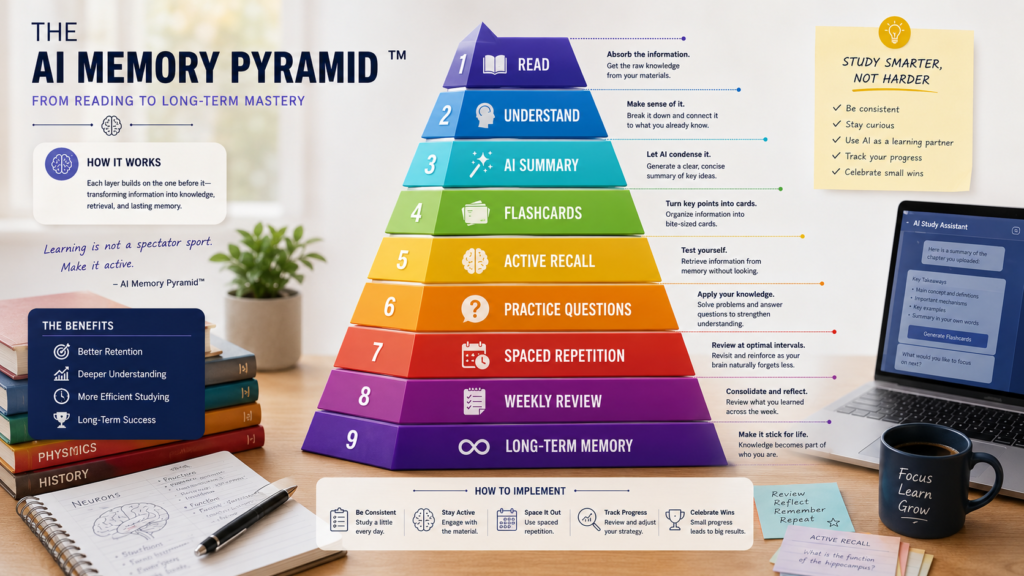
To make this easier to understand, think of memory as a pyramid.
Every layer strengthens the one above it.
If you skip the lower layers, long-term memory becomes much weaker.
The AI Memory Pyramid™ is a practical framework that combines proven learning techniques with AI assistance.
It helps students move beyond simply reading chapters and creates a complete memory-building system.
The workflow looks like this:
Read
↓
Understand
↓
AI Summary
↓
Flashcards
↓
Active Recall
↓
Practice Questions
↓
Spaced Repetition
↓
Weekly Review
↓
Long-Term Memory
Let’s understand each stage.
Read
Every study session starts with reading.
This could be:
• Textbook chapters
• Lecture notes
• Class notes
• PDFs
• Research papers
The goal here is not memorization.
It is simply becoming familiar with the material.
Understand
Reading without understanding creates weak memories.
If a topic feels confusing, ask AI to explain it differently.
For example:
• Explain it like a teacher.
• Use a real-life example.
• Compare it with something familiar.
• Simplify technical language.
Once understanding improves, remembering becomes much easier.
AI Summary
Instead of rereading 30 pages before every revision session, ask AI to create:
• Chapter summaries
• Key concepts
• Important definitions
• Formula sheets
• Exam-focused notes
These summaries reduce revision time while keeping the important information.
Flashcards
Flashcards force your brain to retrieve information.
Instead of looking at notes, you answer questions from memory.
AI can automatically generate dozens of flashcards from:
• Notes
• PDFs
• Chapters
• Lecture slides
Daily flashcard practice strengthens memory far more than passive reading.
Active Recall
This is where real learning begins.
Close your notes.
Answer questions.
Explain concepts aloud.
Teach someone else.
AI can continuously generate fresh questions so that every revision session becomes active rather than passive.
Practice Questions
Once concepts become familiar, begin solving different question types.
Examples:
• MCQs
• Short answers
• Long answers
• Case studies
• Application-based questions
Every correct answer strengthens memory.
Every incorrect answer identifies a weak topic that needs more attention.
Spaced Repetition
Reviewing information only once rarely creates long-term memory.
Instead, review it multiple times across several days.
AI can remind students exactly when each topic should be reviewed.
This reduces forgetting dramatically.
Weekly Review
Many students only revise before exams.
Successful students review every week.
A weekly review session helps connect older topics with new ones.
It also prevents last-minute panic.
Long-Term Memory
By the time students reach this stage, information has been:
• Read
• Understood
• Summarized
• Reviewed
• Tested
• Revised multiple times
This creates knowledge that lasts much longer than simple memorization.
The AI Memory Pyramid™ demonstrates How to Use AI Tools to Remember What You Study Longer by combining proven memory techniques into one workflow.
Step-by-Step AI Memory Workflow
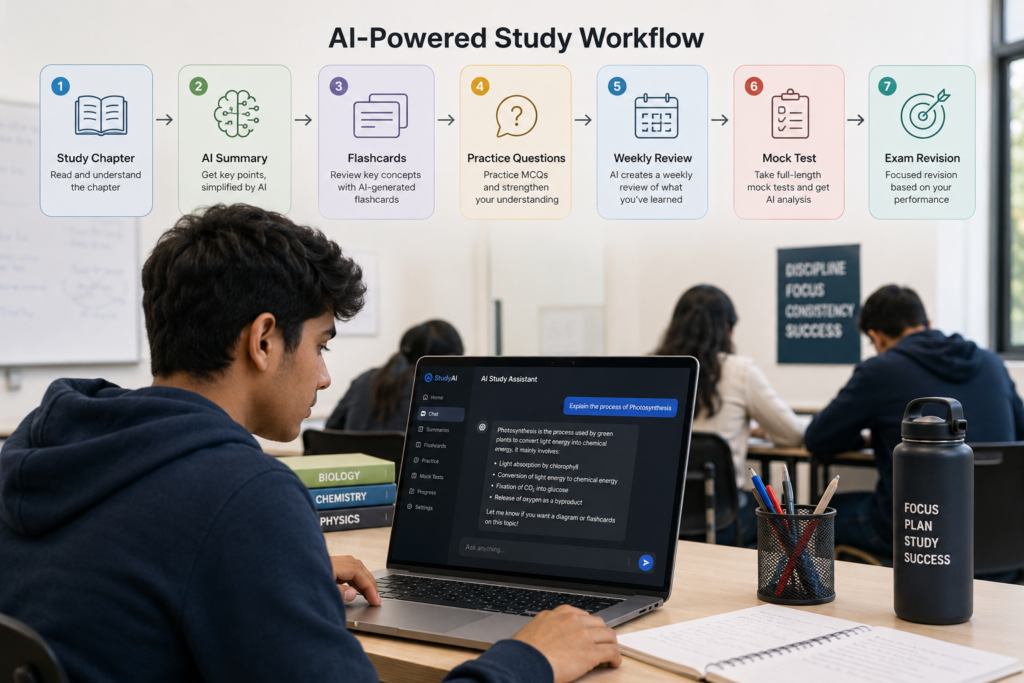
Knowing individual study techniques is helpful.
Following a complete system is even better.
The workflow below combines everything into one practical routine.
Step 1 – Study the Chapter
Start with your textbook, lecture notes, or PDF.
Don’t worry about memorizing every detail
Focus on understanding the overall topic.
Step 2 – Generate an AI Summary
Upload the chapter.
Ask AI to produce:
• Key concepts
• Important definitions
• Formula list
• One-page summary
This becomes your future revision sheet.
Step 3 – Create Flashcards
Now convert those summaries into flashcards.
Instead of writing cards manually, AI creates them within seconds.
Review these cards daily.
Step 4 – Generate Practice Questions
Ask AI to generate:
• 15 MCQs
• 10 short-answer questions
• 5 application questions
Attempt every question without opening your notes.
Step 5 – Identify Weak Areas
Don’t focus only on correct answers.
Incorrect answers are even more valuable.
They show exactly what needs another review.
Step 6 – Schedule Spaced Revision
Ask AI:
> “Create a spaced repetition schedule for this chapter over the next two weeks.”
Now every revision session has a purpose.
Step 7 – Weekly Review
At the end of every week:
• Review flashcards
• Solve new questions
• Read summaries
• Update weak topics
This keeps information active in long-term memory.
Following this workflow is one of the easiest ways to learn How to Use AI Tools to Remember What You Study Longer before exams.
Who Should Use This AI Memory System?
The best part about this workflow is that it works for almost every learner.
School Students
AI helps simplify difficult lessons and create daily revision material.
College Students
Large textbooks become easier to manage through summaries, flashcards, and quizzes.
University Students
Research-heavy subjects become more organized through AI-generated notes and concept mapping.
Competitive Exam Aspirants
Students preparing for:
• UPSC
• NEET
• JEE
• SSC
• Banking
can use AI to continuously revise large syllabuses without becoming overwhelmed.
Self Learners
People learning new skills outside school can use exactly the same workflow to improve long-term knowledge retention.
The AI Memory Loop™
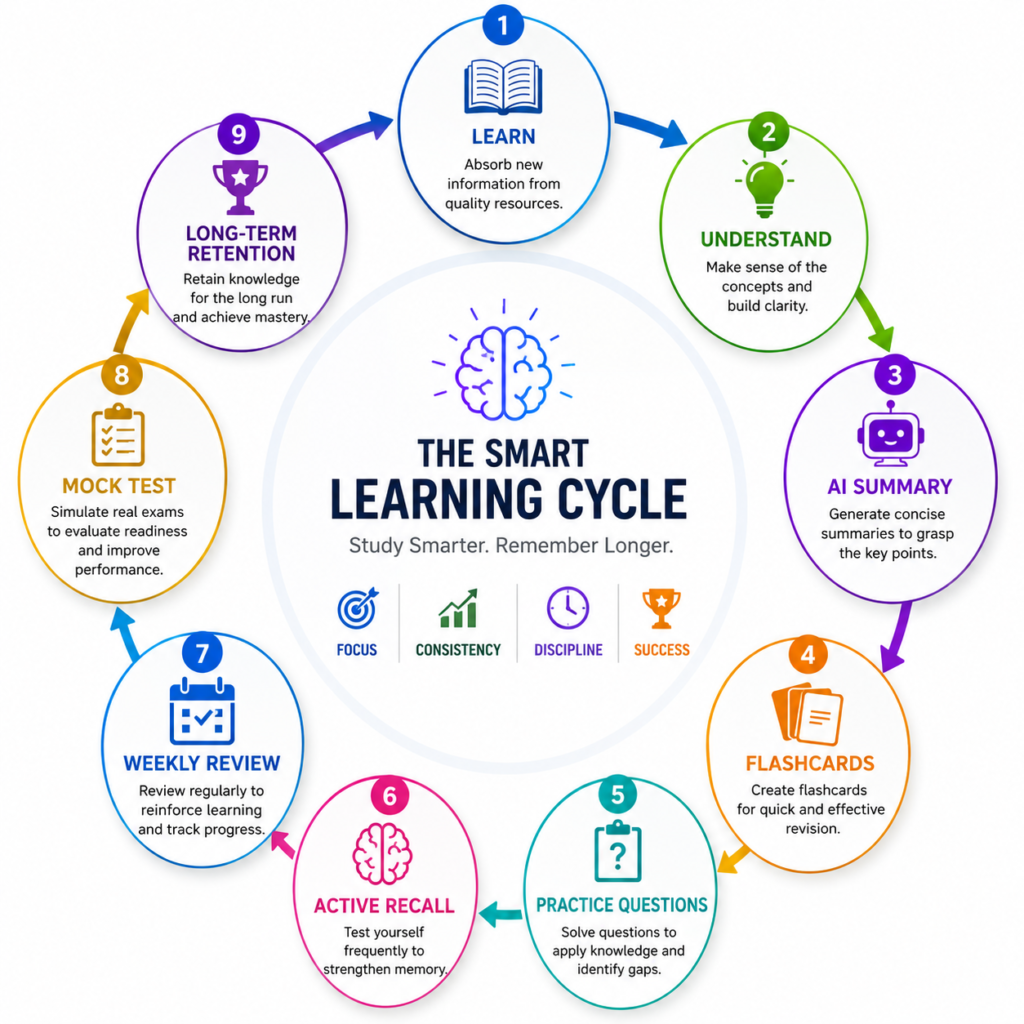
While the AI Memory Pyramid™ explains how memory is built, the AI Memory Loop™ explains how memory is maintained.
Think of it as a cycle that never really ends.
Every review strengthens the previous one.
The workflow looks like this:
Learn
↓
Understand
↓
AI Summary
↓
Flashcards
↓
Practice Questions
↓
Active Recall
↓
Spaced Repetition
↓
Weekly Review
↓
Mock Test
↓
Exam Revision
↓
Long-Term Retention
Unlike cramming, this loop keeps information alive for weeks or even months.
Students who follow this system usually spend less time relearning old topics because the information never completely disappears.
Real Student Example
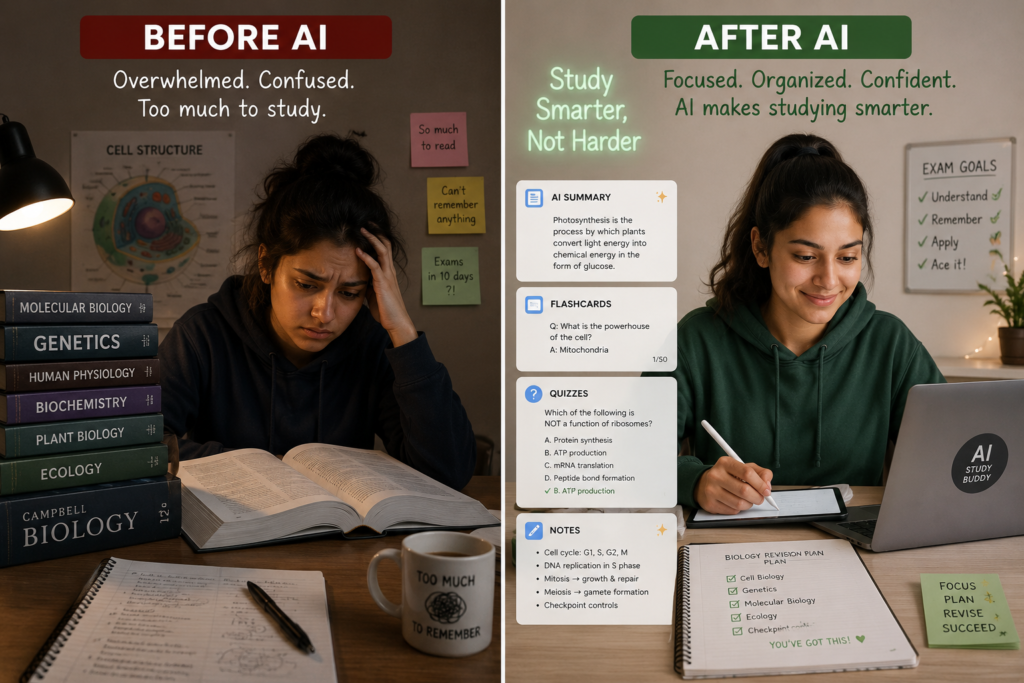
How Maya Remembered an Entire Biology Unit Before Finals
Maya was a second-year college student preparing for her Biology final exam.
Her biggest problem wasn’t understanding the material.
It was remembering it.
Every week she forgot chapters she had already studied.
Instead of rereading the same textbook repeatedly, she changed her approach.
Her workflow looked like this:
Read Chapter
↓
Ask AI for a one-page summary
↓
Generate 30 flashcards
↓
Create 20 practice questions
↓
Review after 24 hours
↓
Review again after one week
↓
Complete a mock test
↓
Final exam revision
By exam week, Maya wasn’t starting from scratch.
She was simply refreshing information that had already been reinforced several times.
The biggest improvement wasn’t studying longer.
It was studying in a way that helped her brain remember
Memory Myths vs Reality
Students often follow study advice that sounds useful but doesn’t actually improve memory.
Let’s separate myths from reality.
Memory Myth Reality
| ❌ Memory Myth | ✅ Reality |
|---|---|
| Reading the same chapter repeatedly improves memory. | Active recall strengthens memory far more effectively. |
| AI can replace studying. | AI should support understanding, not replace learning. |
| Highlighting everything helps you remember. | Retrieving information without looking creates stronger memories. |
| Long study sessions always produce better results. | Short, focused sessions with regular reviews work better. |
| Cramming the night before is enough. | Spaced repetition builds long-term retention. |
| Flashcards are only for memorization. | Good flashcards improve understanding and recall together. |
| Practice questions are only for exams. | They strengthen memory throughout the learning process. |
Understanding these myths helps students build study habits that actually work.
AI vs Traditional Revisio
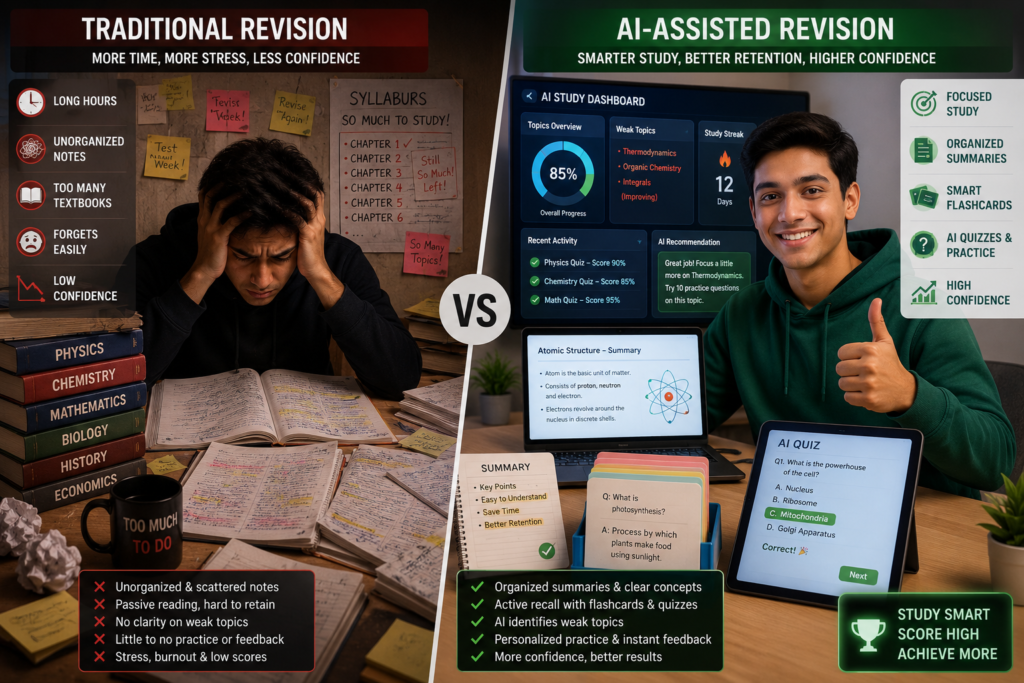
AI should never replace learning.
Instead, it improves how students revise.
| Feature | 📚 Traditional Revision | 🤖 AI-Assisted Revision |
|---|---|---|
| Finding Key Concepts | 🐢 Slow | ⚡ Fast |
| Creating Summaries | ✍️ Manual | 🤖 Automatic |
| Flashcards | 📄 Manual | 🧠 AI Generated |
| Practice Questions | ❌ Limited | ✅ Unlimited |
| Weak Topic Identification | 😓 Difficult | 🎯 Personalized |
| Revision Planning | 📝 Manual | 📅 AI Organized |
| Study Efficiency | 🙂 Moderate | 🚀 Higher |
The goal isn’t to study less.
The goal is to spend more time learning and less time organizing.
Weekly AI Revision Routine
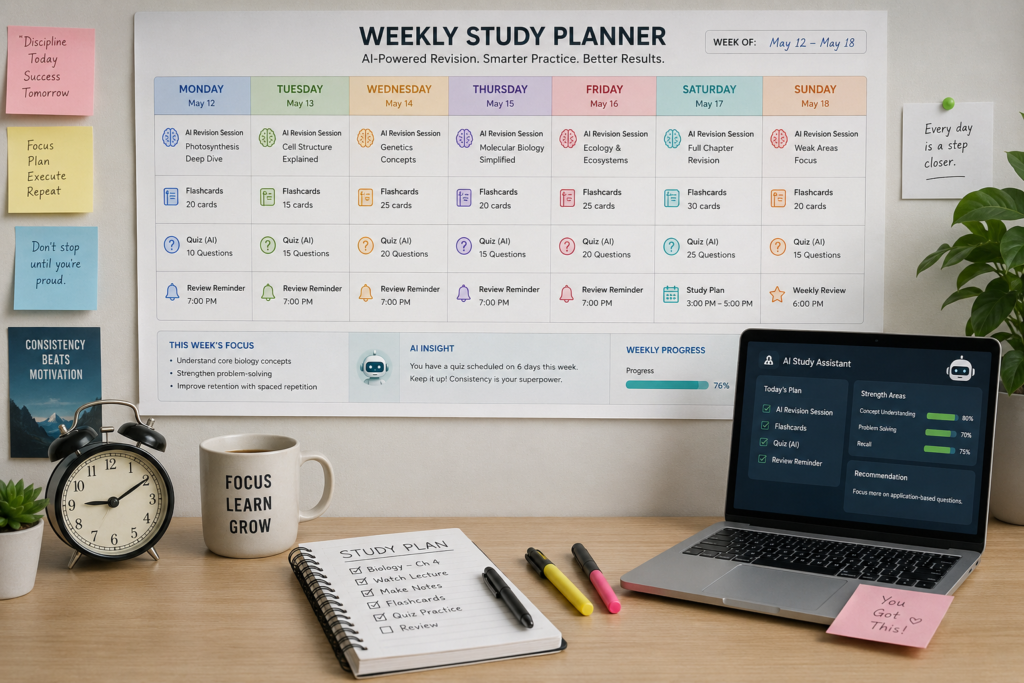
Consistency matters more than intensity.
Here’s a realistic weekly system.
Monday
Study one new chapter.
Generate an AI summary.
Tuesday
Review flashcards.
Answer 15 practice questions.
Wednesday
Review weak topics.
Ask AI to explain difficult concepts.
Thursday
Attempt a mixed-topic quiz.
Identify mistakes.
Friday
Review summaries.
Revise formulas and definitions.
Saturday
Complete a mock test.
Analyze incorrect answers.
Sunday
Weekly review.
Revise flashcards.
Plan next week’s study schedule.
Small weekly reviews prevent information from disappearing.
Students who consistently follow this routine usually find How to Use AI Tools to Remember What You Study Longer much easier to apply in real study sessions.
Best AI Prompts Students Can Use
Good prompts produce better learning.
Here are practical prompts students can copy.
Understanding
• Explain this topic in simple language.
• Teach this concept like a teacher.
• Give a real-life example.
Summaries
• Summarize this chapter into one page.
• Extract the most important concepts.
• Create exam-focused notes.
Flashcards
• Turn these notes into 30 flashcards.
• Create question-and-answer cards.
• Generate vocabulary flashcards.
Practice Questions
• Generate 20 MCQs from this chapter.
• Create short-answer questions.
• Create application-based questions.
• Make a difficult quiz from these notes.
Revision
• Build a spaced repetition schedule.
• Create a weekly revision plan.
• Identify weak topics from these notes.
Memory Improvement
• What concepts should I revise tomorrow?
• Which topics are most likely to appear in exams?
• Help me remember this topic using active recall.
Common Mistakes Students Make
Even with AI, poor habits reduce learning.
Depending Completely on AI
AI is a helper.
You still need to think, solve problems, and understand concepts yourself.
Reading Without Testing Yourself
Recognition is not memory.
Always answer questions without looking at your notes.
Never Reviewing Old Material
Information fades quickly.
Reviewing older topics keeps them active.
Copy-Pasting AI Summaries
Students learn by interacting with information.
Simply saving summaries doesn’t improve memory.
Cramming Before Exams
AI cannot compensate for weeks of missed revision.
Small review sessions remain the best strategy.
Frequently Asked Questions
Can AI help students remember what they study longer?
Yes.
AI supports memory by creating summaries, flashcards, practice questions, and revision schedules that encourage active learning.
What is the best AI study tool for memory retention?
There isn’t one perfect tool.
Many students combine ChatGPT, NotebookLM, Quizlet AI, and other AI study tools depending on their workflow.
Can AI create flashcards automatically?
Yes.
AI can generate flashcards from notes, textbook chapters, PDFs, lecture slides, and study guides.
Can AI generate practice questions?
Yes.
Most modern AI study assistants can create personalized practice questions for self-testing.
Does AI replace studying?
No.
AI improves organization and revision but cannot replace understanding or critical thinking.
How do I use AI tools to remember what I study longer?
You can use AI to summarize chapters, create flashcards, generate practice questions, plan spaced repetition, and review weak topics. Following this workflow consistently makes it much easier to remember what you study for exams.
What is the best way to remember information before exams?
A combination of:
Active recall
Spaced repetition
Flashcards
Practice questions
Weekly review
AI-assisted planning
usually produces the strongest long-term retention.
Final Thoughts
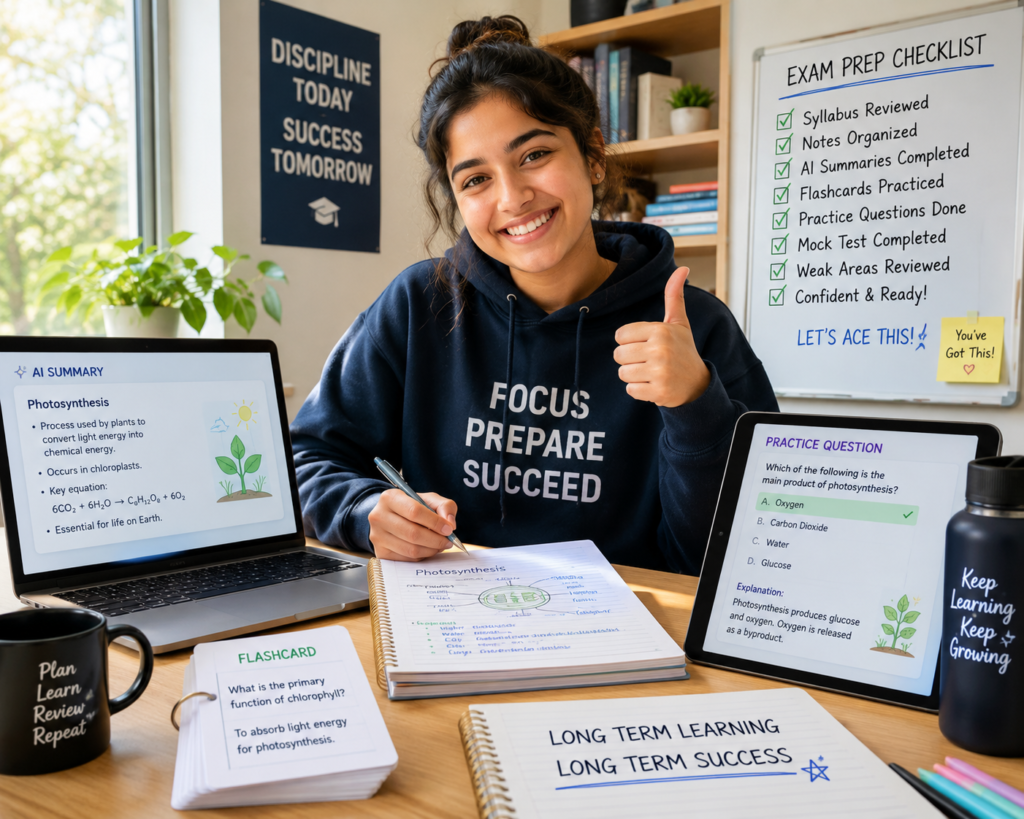
How to Use AI Tools to Remember What You Study Longer is not about having a perfect memory. It’s about building a smarter revision system that helps you retain information for much longer.
It’s about following a system.
Students who retain information for weeks or months usually don’t spend more hours studying.
They spend those hours more effectively.
Using How to Use AI Tools to Remember What You Study Longer as a practical study strategy can help you transform long chapters into summaries, flashcards, practice questions, and structured revision sessions that support long-term memory.
AI should never replace your own thinking.
Instead, let it organize information, identify weak areas, simplify difficult concepts, and make revision more efficient.
The students who benefit most from AI aren’t the ones who let it do the work.
They’re the ones who use AI to build better study habits.
🚀 Continue Your AI Study Journey
Want to study even smarter? Explore these step-by-step AI study guides to improve note-taking, revision, active recall, and exam preparation.
📖 Review Long Chapters with AI
Learn how AI can summarize lengthy textbook chapters into simple, easy-to-review notes.
Read Guide →📝 Generate Practice Questions with AI
Create unlimited practice questions and test your understanding using active recall.
Read Guide →🧠 Create Study Flashcards with AI
Turn important concepts into smart flashcards for faster revision and better memory.
Read Guide →📚 Turn Textbook Pages into Study Notes
Convert textbook content into organized, exam-ready study notes within minutes.
Read Guide →🎤 AI Tools for Automatic Lecture Notes
Automatically transform classroom lectures into structured notes for quick revision.
Read Guide →