Introduction
Science homework can get frustrating fast.
One minute you’re reviewing notes, and the next you’re staring at a physics formula that makes no sense or a chemistry equation that refuses to balance. A lot of students end up searching random websites, watching long videos, or texting friends late at night hoping someone understands the assignment better.
That’s where AI tools can actually help.
If you learn how to use AI tools to solve science homework problems the right way, they can explain difficult concepts, break down steps, simplify diagrams, and help you study smarter instead of just faster. The important part is using AI as a learning assistant — not as a shortcut for copying answers.
This guide explains exactly how students can use AI responsibly for physics, chemistry, and biology homework while actually improving understanding and grades.

Why Students Use AI Tools to Solve Science Homework Problems
Science subjects are different from memorization-heavy classes.
In science, students usually need to:
• understand formulas
• follow steps
• interpret diagrams
• solve numerical problems
• explain processes in their own words
That’s why many students struggle even when they study.
Using AI tools to solve science homework can help because AI can:
• explain difficult ideas in simpler language
• show step-by-step solutions
• answer follow-up questions instantly
• summarize textbook chapters
• help with diagrams and definitions
• provide practice questions
For example:
• A physics problem might require understanding motion formulas.
• A chemistry assignment may involve balancing equations
• A biology worksheet could include complicated cell diagrams.
Instead of spending hours feeling stuck, students can use an AI homework helper to break the problem into smaller pieces.
The biggest advantage is personalization.
Unlike a textbook, AI tools can explain the same concept in multiple ways until it finally clicks.
Students who struggle with equations may also find our guide on AI tools for math homework help useful for improving numerical problem-solving skills.
How We Selected These AI Tools
Choosing an AI tool for science homework is about more than finding something that produces an answer quickly. For this guide, the tools are considered based on how useful they are for actually understanding and working through science problems.
We look at:
• Science problem-solving usefulness — Can the tool help students work through real homework questions?
• Explanation quality — Does it explain the reasoning instead of only producing a result?
• Physics support — How useful is it for formulas, units, calculations, and numerical problems?
• Chemistry support — Can it help students understand equations, reactions, and calculations?
• Biology support — Can it simplify terminology, processes, and concepts?
• Step-by-step learning value — Does the tool help students understand how an answer is reached?
• Ease of use — Can a student start using it without a complicated setup?
• Free availability — Is there a meaningful free option or free access available?
• Limitations — What types of mistakes or gaps should students watch for?
• Overall student usefulness — Does the tool solve a genuine homework problem without encouraging answer copying?
No single tool is ideal for every science assignment. A strong choice depends on whether you’re solving a physics numerical, balancing a chemistry equation, understanding a biology process, checking your reasoning, or simply trying to understand a difficult concept.
Step-by-Step Guide — How to Use AI Tools to Solve Science Homework Problems
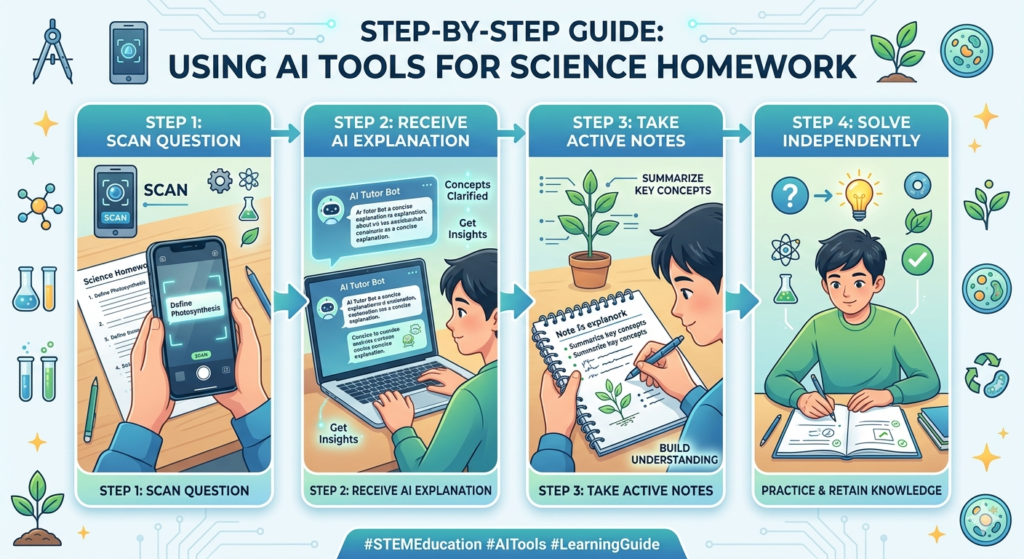
A lot of students make one major mistake:
They paste the homework question, copy the answer, and move on.
That usually hurts learning in the long run because science builds on previous concepts. If you skip understanding now, future chapters become harder.
Here’s a smarter system.
Step 1 — Read and Understand the Question
Before opening an AI tool, read the problem yourself.
🔎 Ask Yourself
- What subject is this?
- What information is given?
- What exactly do I need to find?
- Which concept does the question appear to test?
Step 2 — Identify What Is Given and What Needs to Be Found
For numerical science problems, separate the information before asking AI for help.
📌 Given
Distance = 120 m
Time = 6 s
🎯 Find
Speed
Step 3 — Ask AI for an Explanation or Guided Solution
Instead of asking AI for the final answer, ask it to guide you through the reasoning.
❌ Don’t Ask
“Give me the answer.”
✅ Better Prompt
“Help me solve this science problem step by step. First identify the concept and the information given. Don’t give me the final answer until I have worked through the steps.”
🧪 Chemistry
“Explain why this chemical equation needs these coefficients. Show me the balancing process and let me check each step.”
🧬 Biology
“Explain this biological process in simple language, then give me a more detailed explanation using the correct scientific terminology.”
Step 4 — Verify the Explanation or Answer
Check important answers against:
For calculations, check whether the units and mathematical steps make sense.
For biology, check whether terminology and processes match your course materials.
For chemistry, check formulas, coefficients, units, and reaction details.
Step 5 — Solve or Reproduce the Problem Yourself
Close the AI tool. Now solve the problem independently.
If you can’t reproduce the solution without looking at the AI response, you probably need another explanation or another practice attempt.
Step 6 — Practice With a Similar Problem
Ask AI to create a new problem using the same concept.
📝 Try This Prompt
“Create three similar physics problems using the same concept but different numbers. Don’t show the solutions until I attempt them.”
How to Use AI Tools to Solve Science Homework Problems in Physics
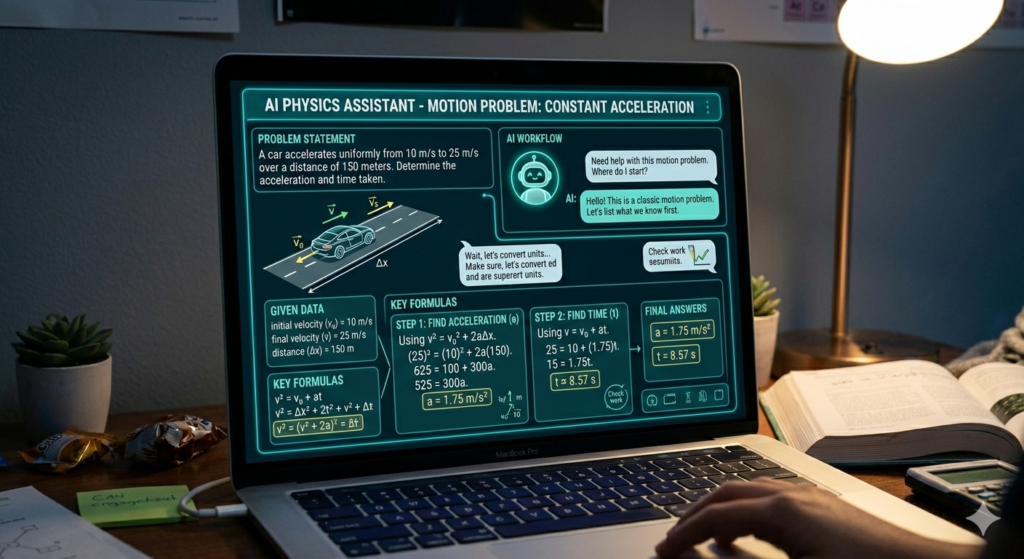
Physics is one of the best subjects for AI support because many students struggle with formulas and numerical calculations.
Example — Motion Problem
Problem:
A car travels 120 meters in 6 seconds. What is its speed?
A student using an AI homework helper might type:
“Explain how to solve this speed problem step by step.”
The AI could explain:
Speed = Distance ÷ Time v = d / t
Then it may guide the student:
- Identify distance = 120 meters
- Identify time = 6 seconds
- Divide distance by time
- Final answer = 20 m/s
The useful part is not the final number.
The useful part is understanding:
• what the formula means
• why the values are divided
• when to use the formula again
A student can then practice similar problems independently instead of memorizing one answer.
Best Physics AI Tools
• Wolfram Alpha → advanced calculations
• Photomath → numerical step breakdowns
• ChatGPT → concept explanations
How to Use AI Tools to Solve Science Homework Problems in Chemistry
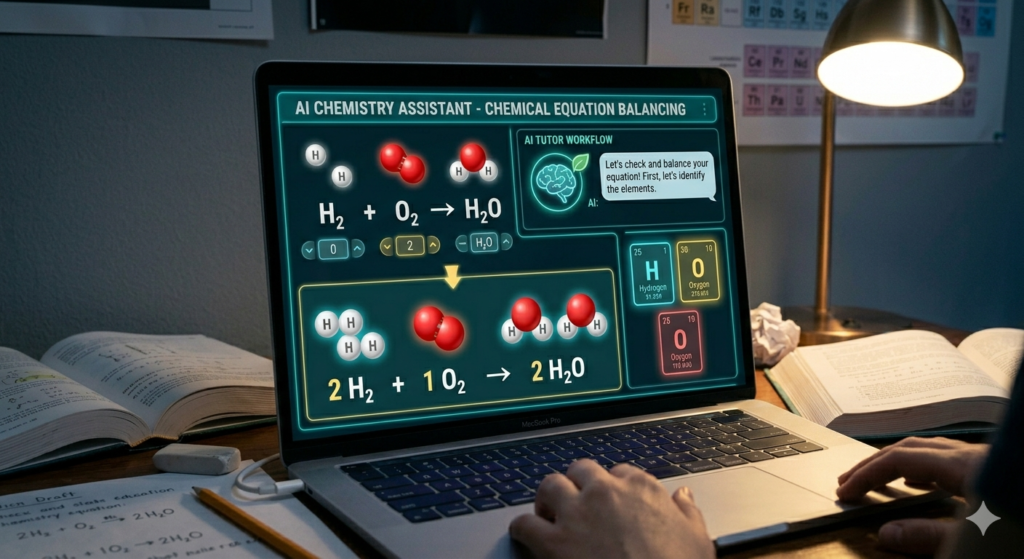
Chemistry becomes difficult when equations, reactions, and calculations start mixing together.
AI tools can simplify each step.
Example — Balancing a Chemical Equation
Problem
Balance: H₂ + O₂ → H₂O
A student could ask:
“Teach me how to balance this equation step by step.”
The AI may explain:
- Count atoms on both sides
- Oxygen atoms are uneven
- Add coefficients slowly
- Check hydrogen again
Final balanced equation:
2H_2 + o_2 → 2H_2o
The important learning point: Students should understand why numbers were added instead of blindly copying the equation.
Stoichiometry Example
Students can also ask AI:
• how mole ratios work
• how to convert grams to moles
• why certain formulas apply
Science problem-solving AI tools are especially useful here because chemistry often requires multiple small steps.
Best Chemistry AI Tools
• ChatGPT → detailed explanations
• Socratic → visual homework help
• Wolfram Alpha → calculations
How to Use AI Tools to Solve Science Homework Problems in Biology
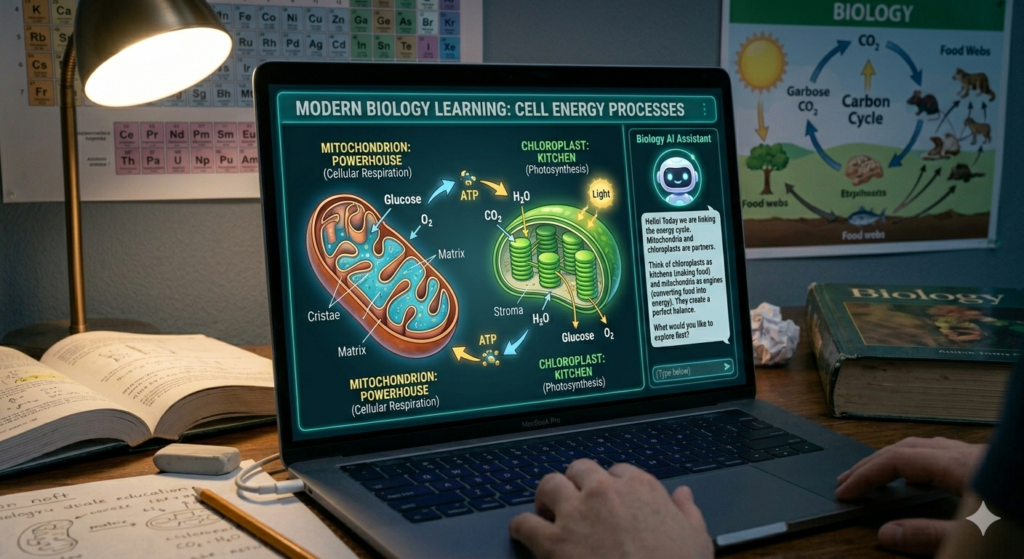
Biology homework often looks easier at first — until students face:
• diagrams
• long processes
• scientific vocabulary
• cell structures
• genetics
AI tools help by simplifying complex explanations.
Example — Cell Structure Homework
Problem:
Explain the function of mitochondria.
Instead of copying a textbook definition, a student can ask:
“Explain mitochondria in simple words for high school students.”
AI may explain:
• mitochondria create energy for cells
• they act like the “powerhouse” of the cell
• they help cells perform activities
That simplified explanation helps students actually remember the concept.
Example — Photosynthesis Process
AI can also explain processes step by step:
6Co2 + 6H2o + light → C6H12o6 + 6o2
Then students can ask:
• why sunlight matters
• where chlorophyll works
• how plants use glucose
That type of interaction improves understanding much more than memorizing paragraphs.
Best Biology AI Tools
• Khanmigo → guided learning
• NoteGPT→ summaries and notes
• ChatGPT → concept explanations
Ethical Use of AI Tools for Science Homework

Students should understand one thing clearly:
AI should help students learn — not replace learning.
Using AI tools to solve science homework responsibly means:
• understanding the steps
• verifying answers
• Rewriting responses yourself
• practicing independently afterward
AI can make mistakes sometimes.
A science formula might be wrong. An explanation may miss details. A diagram description could be incomplete.
That’s why important answers should still be checked using:
• textbooks
• teacher notes
• trusted educational websites
• classroom examples
Good students use AI like a study partner, not an automatic answer machine.
A simple rule:
If you cannot explain the answer yourself afterward, you probably did not learn it properly.
Best AI Tools for Science Homework
Here are some of the most useful AI tools for students who want to solve science homework using AI while still learning concepts clearly.
🤖 ChatGPT
A versatile AI learning assistant for science homework, explanations, and guided problem solving.
🎯 Best For
General science explanations, step-by-step guidance, and follow-up questions.
💪 Strengths
- Explains physics, chemistry, and biology concepts in plain language
- Breaks difficult science problems into smaller steps
- Allows students to ask follow-up questions until a concept makes sense
- Creates similar practice questions after explaining a problem
- Helps students check their reasoning instead of only producing a final answer
⚠️ Limitations
- Can occasionally produce incorrect scientific information or calculations
- Important formulas, facts, and numerical answers should be verified
- A detailed explanation is not automatically a correct explanation
💳 Free or Paid
Paid plans provide access to additional models, capabilities, and higher usage limits. Specific features can vary by plan.
🌐 Official Website
Visit ChatGPT →🎓 Best Student Use
Ask ChatGPT to teach the method first, then solve the problem instead of immediately requesting the final answer. This approach can help students understand the reasoning behind a science problem and practice the method independently.
📚 Learning Note
OpenAI’s education resources describe ChatGPT as a learning tool that can help students understand difficult concepts and turn course material into study resources.
📸 Socratic by Google
A visual learning assistant for homework questions, explanations, examples, and educational resources.
🎯 Best For
Photographing homework questions and finding explanations and learning resources.
💪 Strengths
- Students can enter questions using a photo, text, or voice input
- Useful for questions printed in textbooks or worksheets
- Provides concept overviews and explanatory steps
- Can surface example problems and educational videos
- Helps students explore related learning resources instead of relying on one answer
⚠️ Limitations
- Better suited to quick question discovery and learning resources than advanced open-ended science reasoning
- Students still need to understand and check the explanations
- The quality and depth of available resources can vary by question
💳 Free or Paid
Socratic is provided as a Google learning resource, with results that connect students to educational material from across the web.
🌐 Official Website
Visit Socratic by Google →🎓 Best Student Use
Take a photo of a confusing science question, review the explanations and related resources, then solve the problem yourself. This makes Socratic more useful as a learning companion rather than simply an answer finder.
📚 Learning Note
Google’s documentation says Socratic can analyze photo, text, and voice questions and provide concept overviews, explanatory steps, example problems, video walkthroughs, and related educational resources.
🧮 Wolfram|Alpha
A computational learning tool for physics calculations, formulas, quantitative chemistry, and mathematical problem solving.
🎯 Best For
Physics calculations, formulas, quantitative chemistry, and mathematical problem solving.
💪 Strengths
- Strong computational engine for formula-based problems
- Useful for checking numerical calculations
- Handles mathematical operations used in physics and chemistry
- Pro provides step-by-step solutions for supported problems
- Pro includes practice problems with hints and step-by-step solutions
⚠️ Limitations
- More calculation-focused than conversational AI
- Can feel less intuitive when the underlying science is unclear
- Free Basic access does not include step-by-step solutions
💳 Free or Paid
The free Basic tier provides access to Wolfram|Alpha’s core computational experience. Pro adds features such as step-by-step solutions, practice problems, additional computation time, and other enhanced capabilities.
🌐 Official Website
Visit Wolfram|Alpha →🎓 Best Student Use
Use Wolfram|Alpha to check the mathematical side of a science problem, then return to your notes, teacher, or learning resource to understand the science behind the calculation. This works especially well for quantitative physics and chemistry problems.
📚 Learning Note
Wolfram|Alpha provides computational tools for science and mathematics, while its Pro step-by-step features cover supported math, chemistry, and physics problems and show intermediate solution steps.
🧑🏫 Khanmigo
An AI tutor designed to guide students through concepts, questions, and science problems instead of simply giving the final answer.
🎯 Best For
Guided learning, tutor-style help, science explanations, and working through difficult problems step by step.
💪 Strengths
- Designed around learning rather than simply displaying an answer
- Encourages students to work through problems themselves
- Supports follow-up questions and guided explanations
- Useful for science subjects including biology, chemistry, and physics
- Works well when students need help understanding why an answer works
⚠️ Limitations
- Availability and access can depend on location, account, or educational program
- May not be the best choice when a student only wants a quick numerical calculation
- Students should still verify important scientific information
- AI tutoring works best alongside actual practice and course materials
💳 Free or Paid
Khan Academy’s core learning platform is free for independent learners. Khanmigo access and pricing can vary depending on the current offering, location, account type, or educational program.
🌐 Official Website
Visit Khanmigo →🎓 Best Student Use
Use Khanmigo when your goal is to understand the problem. Ask it to guide you through the concept, identify what you already know, and help you work toward the solution rather than immediately requesting the final answer.
📚 Learning Note
Khan Academy describes Khanmigo as an AI tutor whose role is to help students when they are stuck or unsure while keeping practice and understanding at the center of learning.
📝 NoteGPT
An AI learning assistant for turning long study material into summaries, notes, mind maps, and revision resources.
🎯 Best For
Turning long learning material into summaries, notes, and revision resources.
💪 Strengths
- Useful for summarizing lengthy explanations and study material
- Helps turn learning content into more manageable notes
- Supports summary and mind-map style study workflows
- Useful when students need to review large amounts of material
- Can complement science homework by making background material easier to revise
⚠️ Limitations
- Not the strongest choice for calculation-heavy physics or chemistry problems
- Summaries can leave out details that matter for scientific understanding
- Important information should be compared with the original material
💳 Free or Paid
The current free plan provides 15 quotas per month. Paid plans increase usage limits and provide additional capabilities through basic quotas and premium credits.
🌐 Official Website
Visit NoteGPT →🎓 Best Student Use
Use NoteGPT before or after science homework to turn long lectures, articles, PDFs, or other learning material into concise revision notes and visual study resources. For calculation-heavy problems, pair it with a dedicated science or mathematics problem-solving tool.
📚 Learning Note
NoteGPT currently offers summarization, mind maps, AI chat, transcription, PDF tools, and other learning features. Its official site positions it as an all-in-one AI learning assistant for students and other learners.
🧪 Edubrain
An AI homework assistant for direct science questions, step-by-step explanations, and structured academic support.
🎯 Best For
Direct homework assistance and step-by-step science help.
💪 Strengths
- Built specifically around homework assistance
- Supports a wide range of science subjects including physics, chemistry, biology, and general science
- Provides step-by-step explanations alongside answers
- Accepts questions through text, images, PDFs, and audio
- Offers additional study tools such as flashcards, notes, diagrams, and research assistance
⚠️ Limitations
- Students should verify important science answers before relying on them
- A generated solution may not explain every underlying scientific concept
- The free experience includes advertisements
- Advanced reasoning and additional features are available through paid access
💳 Free or Paid
The current Free plan includes unlimited use with ads and access to the AI tools. AI-Plus adds advanced reasoning and additional ad-free features. Expert-help services are also available separately.
🌐 Official Website
Visit Edubrain →🎓 Best Student Use
Use Edubrain when you have a specific science homework question and want structured, step-by-step assistance. After reviewing the explanation, solve a similar problem yourself and verify important results before using them in submitted work.
📚 Learning Note
Edubrain’s science helper is designed to explain science problems through readable steps and supports physics, chemistry, biology, earth science, environmental science, and other science topics. Its broader platform also includes tools for notes, flashcards, diagrams, and research.
📐 Photomath
A visual math-learning tool that helps students scan problems, check calculations, and understand step-by-step solutions.
🎯 Best For
Numerical science problems, equations, and the mathematics used in physics or chemistry homework.
💪 Strengths
- Designed specifically for solving and learning mathematics
- Can scan problems using a phone camera
- Provides step-by-step explanations for supported problems
- Useful for checking calculations used in physics and chemistry
- Can help students identify where their mathematical work went wrong
⚠️ Limitations
- Primarily a mathematics tool rather than a complete science tutor
- Less useful for conceptual biology or theory-heavy science questions
- Students still need to understand what a calculation represents scientifically
💳 Free or Paid
The current Basic plan includes step-by-step explanations. Photomath Plus adds features such as custom visual aids and additional “how” and “why” explanations. Current pricing shown by Photomath is $9.99/month or $69.99/year.
🌐 Official Website
Visit Photomath →🎓 Best Student Use
Use Photomath when the mathematical part of a science problem is causing difficulty. Check the calculation step by step, then return to the physics or chemistry concept to understand what the numbers actually represent.
📚 Learning Note
Photomath is built around showing the work behind a mathematical answer. Its official resources emphasize step-by-step explanations so students can understand the process rather than simply see the final result.
Comparison Table of AI Tools for Science Homework
Here’s a quick comparison of the most useful AI science homework tools for students.
🔎 AI Science Homework Tools Comparison
Compare the leading AI science homework tools by their primary use, pricing, key features, strengths, and limitations.
| 🤖 AI Tool | 🎯 Best For | 💳 Free/Paid | ⚙️ Key Features | 💚 Pros | ⚠️ Cons |
|---|---|---|---|---|---|
| 🤖 ChatGPT | Overall science help | Free + Paid | Explanations, Q&A | Flexible and conversational | Needs fact-checking |
| 📸 Socratic | Quick homework scans | Free | Camera-based solving | Easy for beginners | Limited depth |
| 🧮 Wolfram Alpha | Physics numericals | Free + Paid | Formula solving | Accurate calculations | Complex interface |
| 🧑🏫 Khanmigo | Guided learning | Limited Free | Learning-focused AI | Encourages understanding | Limited access |
| 📝 NoteGPT | Notes and summaries | Free + Paid | Quick summaries | Good for revision | Weak for calculations |
| 🧪 Edubrain | Homework support | Free + Paid | AI assistance | Fast responses | Some answers too short |
| 📐 Photomath | Equations and numericals | Free + Paid | Step-by-step solving | Excellent for calculations | Less theory support |
⚡ Quick Takeaway
Overall science help: ChatGPT • Quick scans: Socratic • Physics numericals: Wolfram Alpha • Guided learning: Khanmigo • Notes & summaries: NoteGPT • Homework support: Edubrain • Equations: Photomath
Best AI Tool by Student Situation
The “best” science homework tool depends on the problem you’re actually trying to solve.
A student working through a physics numerical needs different help from someone trying to understand photosynthesis or check a chemistry calculation.
Use this table to choose based on your situation.
🎯 Which AI Tool Should You Use for Each Science Task?
The best AI science homework tool depends on the type of problem you are trying to solve. Use this quick guide to match each science task with the most suitable tool or approach.
| 🎓 Student Situation | 🤖 Best Tool / Tool Type | 💡 Why It Helps |
|---|---|---|
| ⚡ Physics numerical/problem | Wolfram|Alpha Calculation-focused tool | Useful for mathematical and computational work; students should still check units and reasoning. |
| 🧪 Chemistry equation or calculation | ChatGPT + Calculation tool | ChatGPT can explain the chemistry while a computational tool can help check calculations. |
| 🧬 Biology concept | ChatGPT or Khanmigo | Useful for simplifying terminology and explaining biological processes step by step. |
| 📸 Science homework question from a photo | Socratic | Students can enter a question using a photo and receive relevant educational resources and explanations. |
| 🔍 Need to verify an answer | AI + Textbook/Class Notes | Comparing independent sources is safer than trusting one AI response. |
| 🪜 Need a step-by-step explanation | ChatGPT or Guided-learning tool | Ask for hints and reasoning rather than requesting only the final answer. |
| 📝 Need practice questions | ChatGPT or Educational practice platform | Generate similar problems and solve them independently. |
| 💡 Difficult science concept | ChatGPT or Khanmigo | Useful for changing the explanation level and asking follow-up questions until the concept becomes clearer. |
⚡ Quick Decision
Calculations? Use Wolfram|Alpha or a calculation-focused tool. Concepts? Try ChatGPT or Khanmigo. Photo question? Use Socratic. Need verification? Compare AI with your textbook and class notes.
Quick Decision Rule
Physics calculation? Start with a calculation-focused tool.
Chemistry process or equation? Use AI for the explanation and independently check the chemistry.
Biology concept? Choose a tool that can explain terminology and processes in simpler language.
Homework photo? A photo-based tool such as Socratic can help you locate explanations and related educational resources.
Unsure whether your answer is correct? Don’t ask one AI system to simply say “correct.” Compare your reasoning with your class notes, textbook, and another reliable source.
Subject-Specific AI Recommendations
Physics
Best tools:
• Wolfram Alpha
• Photomath
• ChatGPT
Chemistry
Best tools:
• ChatGPT
• Socratic
• Wolfram Alpha
Biology
Best tools:
• Khanmigo
• NoteGPT
• ChatGPT
Internal Learning Ideas for Students
Students can also combine AI tools with:
• class notes
• flashcards
• practice worksheets
• science videos
• revision quizzes
Helpful related topics:
• AI tools for math homework help
• Best study techniques for science exams
• How to prepare for physics tests without cramming
Conclusion — How to Use AI Tools to Solve Science Homework Problems the Smart Way

Learning how to use AI tools to solve science homework problems can make studying less stressful and much more manageable for high school students.
The best results happen when students use AI to:
• understand difficult concepts
• break problems into steps
• practice independently
• improve confidence gradually
AI tools to help with science homework are powerful, but they work best when combined with real effort and curiosity.
So the next time students feel stuck on a physics equation, chemistry reaction, or biology concept, they should not rush to copy the answer.
Use AI to learn the process.
Ask questions. Practice the steps. Rewrite explanations in your own words.
Start with one difficult science problem today and use AI to understand every step instead of memorizing the answer.
That’s how science starts making sense — one problem at a time.
📚 Continue Learning
Keep building your science learning system with these related AI guides from IndiaAITools.
AI Tools for Reading PDFs for Students
Read textbooks, lecture notes, research papers, and other long science materials faster with AI assistance.
Explore Guide →Best AI Note-Taking Apps for College Students
Capture, organize, and review class notes more effectively with AI-powered note-taking tools.
Explore Guide →How to Create Study Flashcards With AI
Turn science notes and study material into AI-powered flashcards for active recall and revision.
Explore Guide →Best AI Tools for Students Preparing for Exams at the Last Minute
Build a focused last-minute revision workflow with AI-powered summaries, practice questions, and study support.
Explore Guide →💡 Build Your Next Step
Use these guides together: understand long material with AI, organize your notes, turn key concepts into flashcards, and finish with focused exam revision.
❓ Frequently Asked Questions
Get clear answers to the most common questions students ask about using AI for science homework.
Is AI good for science homework?
+
What is the best AI tool for science homework?
+
Can AI solve science homework step by step?
+
What is the best AI tool for Physics homework?
+
Can AI help with Chemistry homework?
+
Can I use AI to solve a science homework question from a photo?
+
Should I copy an AI-generated science answer?
+
🎓 Smart AI Homework Rule
Use AI to understand, practice, and improve your reasoning—not simply to copy answers. The strongest science homework workflow combines AI guidance with your own thinking, trusted course materials, and independent practice.